part c assign oxidation numbers to each atom present in the chemical reaction using the table provided…
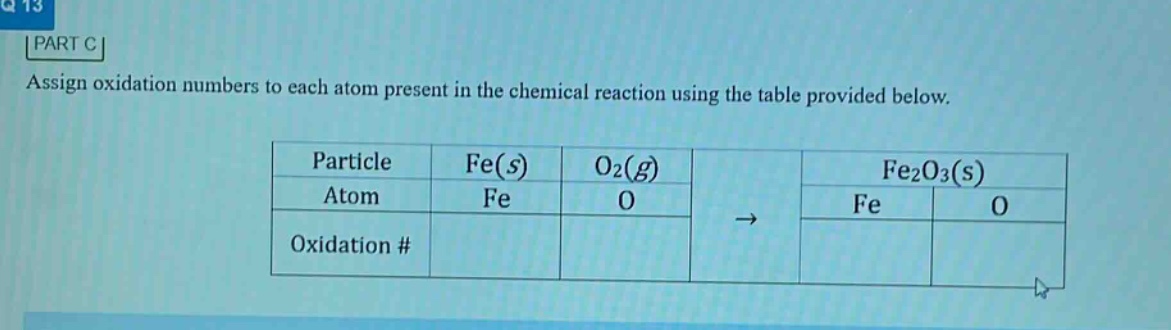
part c assign oxidation numbers to each atom present in the chemical reaction using the table provided below. particle fe(s) o2(g) fe2o3(s) atom fe o fe o oxidation #
Answer
Explanation:
Step1: Oxidation number of Fe in Fe(s)
Elements in their free - state have an oxidation number of 0. So, for Fe(s), the oxidation number of Fe is 0.
Step2: Oxidation number of O in O₂(g)
Elements in their free - state have an oxidation number of 0. So, for O₂(g), the oxidation number of O is 0.
Step3: Oxidation number of O in Fe₂O₃(s)
In compounds, oxygen usually has an oxidation number of - 2. So, in Fe₂O₃(s), the oxidation number of O is - 2.
Step4: Oxidation number of Fe in Fe₂O₃(s)
Let the oxidation number of Fe be (x). In Fe₂O₃, we have 2 Fe atoms and 3 O atoms. The sum of oxidation numbers in a neutral compound is 0. So, (2x+3\times(- 2)=0). Solving for (x): [ \begin{align*} 2x-6&=0\ 2x&=6\ x& = + 3 \end{align*} ]
Answer:
| Particle | Fe(s) | O₂(g) | Fe₂O₃(s) |
|---|---|---|---|
| Atom | Fe | O | Fe |
| Oxidation # | 0 | 0 | +3 |