part 1 of 2\nwhich of the following reactions will produce a precipitate? select the single best…
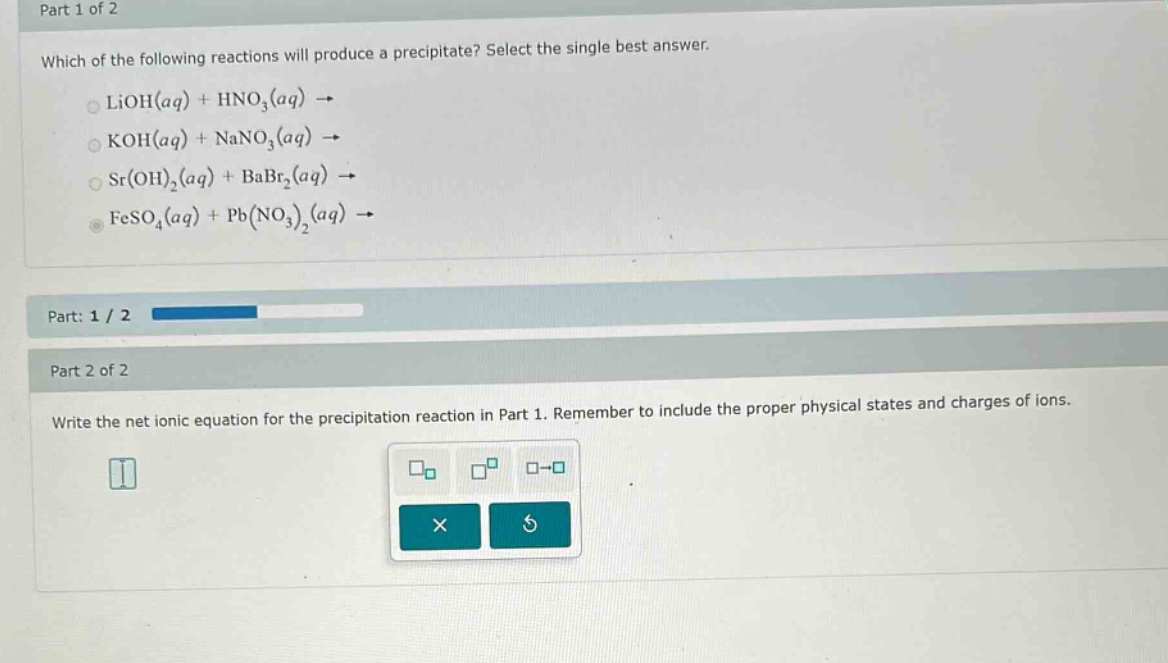
part 1 of 2\nwhich of the following reactions will produce a precipitate? select the single best answer.\nlioh(aq) + hno3(aq) →\nkoh(aq) + nano3(aq) →\nsr(oh)2(aq) + babr2(aq) →\nfeso4(aq) + pb(no3)2(aq) →\npart: 1 / 2\npart 2 of 2\nwrite the net ionic equation for the precipitation reaction in part 1. remember to include the proper physical states and charges of ions.
Answer
Explanation:
Step1: Analyze first reaction
$LiOH(aq)+HNO_3(aq)\rightarrow LiNO_3(aq) + H_2O(l)$. No precipitate as all products are soluble.
Step2: Analyze second reaction
$KOH(aq)+NaNO_3(aq)\rightarrow$ No reaction as no gas, water or precipitate is formed.
Step3: Analyze third reaction
$Sr(OH)_2(aq)+BaBr_2(aq)\rightarrow$ No reaction as no gas, water or precipitate is formed.
Step4: Analyze fourth reaction
$FeSO_4(aq)+Pb(NO_3)_2(aq)\rightarrow PbSO_4(s)+Fe(NO_3)_2(aq)$. $PbSO_4$ is insoluble, so it forms a precipitate.
Step5: Write net - ionic equation for fourth reaction
The complete ionic equation is $Fe^{2 + }(aq)+SO_4^{2 - }(aq)+Pb^{2 + }(aq)+2NO_3^{-}(aq)\rightarrow PbSO_4(s)+Fe^{2 + }(aq)+2NO_3^{-}(aq)$. Canceling out the spectator ions ($Fe^{2 + }$ and $NO_3^{-}$), the net - ionic equation is $Pb^{2 + }(aq)+SO_4^{2 - }(aq)\rightarrow PbSO_4(s)$.
Answer:
Part 1: $FeSO_4(aq)+Pb(NO_3)_2(aq)\rightarrow$ Part 2: $Pb^{2 + }(aq)+SO_4^{2 - }(aq)\rightarrow PbSO_4(s)$