part of one row of the periodic table is shown. which elements atoms have the greatest average number of…
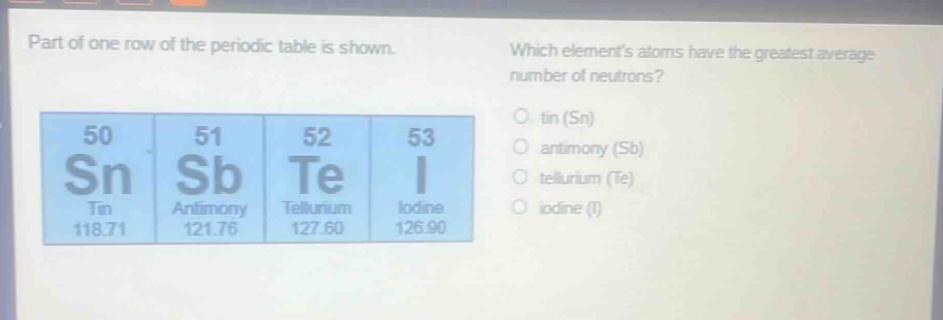
part of one row of the periodic table is shown. which elements atoms have the greatest average number of neutrons? tin (sn) antimony (sb) tellurium (te) iodine (i)
Answer
Explanation:
Step1: Recall the formula for number of neutrons
The number of neutrons (N) in an atom is given by (N = A - Z), where (A) is the atomic mass (average atomic mass from the periodic table) and (Z) is the atomic number (the integer in the box).
Step2: Calculate neutrons for Sn
For tin ((Sn)): (Z = 50), (A=118.71). Then (N_{Sn}=118.71 - 50=68.71)
Step3: Calculate neutrons for Sb
For antimony ((Sb)): (Z = 51), (A = 121.76). Then (N_{Sb}=121.76-51 = 70.76)
Step4: Calculate neutrons for Te
For tellurium ((Te)): (Z = 52), (A=127.60). Then (N_{Te}=127.60 - 52=75.6)
Step5: Calculate neutrons for I
For iodine ((I)): (Z = 53), (A = 126.90). Then (N_{I}=126.90-53=73.9)
Answer:
tellurium ((Te))