part b refer to the observations of the test tubes from part a. determine which metal (or hydrogen) in each…
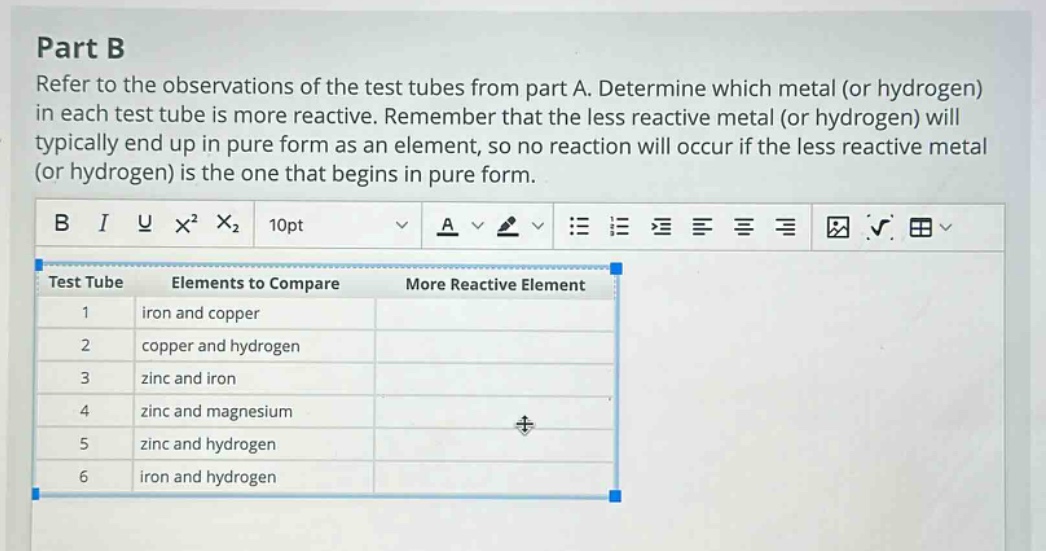
part b refer to the observations of the test tubes from part a. determine which metal (or hydrogen) in each test tube is more reactive. remember that the less reactive metal (or hydrogen) will typically end up in pure form as an element, so no reaction will occur if the less reactive metal (or hydrogen) is the one that begins in pure form. test tube elements to compare more reactive element 1 iron and copper 2 copper and hydrogen 3 zinc and iron 4 zinc and magnesium 5 zinc and hydrogen 6 iron and hydrogen
Answer
Explanation:
Step1: Recall reactivity series
The reactivity series of metals (and hydrogen) is used to determine which is more reactive.
Step2: Compare iron and copper
In the reactivity series, iron is more reactive than copper.
Step3: Compare copper and hydrogen
Hydrogen is more reactive than copper.
Step4: Compare zinc and iron
Zinc is more reactive than iron.
Step5: Compare zinc and magnesium
Magnesium is more reactive than zinc.
Step6: Compare zinc and hydrogen
Zinc is more reactive than hydrogen.
Step7: Compare iron and hydrogen
Iron is more reactive than hydrogen.
Answer:
- Iron
- Hydrogen
- Zinc
- Magnesium
- Zinc
- Iron