this passage describes a chemical reaction. read the passage. then, follow the instructions below. soda…
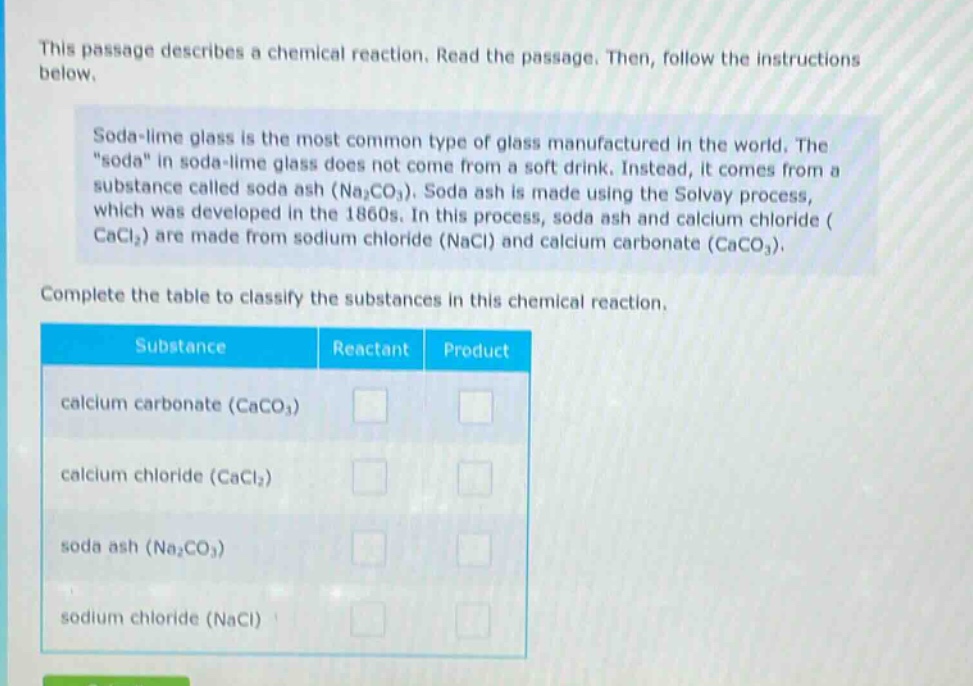
this passage describes a chemical reaction. read the passage. then, follow the instructions below. soda - lime glass is the most common type of glass manufactured in the world. the \soda\ in soda - lime glass does not come from a soft drink. instead, it comes from a substance called soda ash (na2co3). soda ash is made using the solvay process, which was developed in the 1860s. in this process, soda ash and calcium chloride (cacl2) are made from sodium chloride (nacl) and calcium carbonate (caco3). complete the table to classify the substances in this chemical reaction. substance reactant product calcium carbonate (caco3) calcium chloride (cacl2) soda ash (na2co3) sodium chloride (nacl)
Answer
Explanation:
Step1: Identify reactants and products
Reactants are starting - materials, products are end - results. Given that sodium chloride (NaCl) and calcium carbonate (CaCO₃) are used to make soda ash (Na₂CO₃) and calcium chloride (CaCl₂).
Step2: Classify substances
Calcium carbonate (CaCO₃) is a reactant. So, for calcium carbonate (CaCO₃): Reactant - √, Product - (empty). Calcium chloride (CaCl₂) is a product. So, for calcium chloride (CaCl₂): Reactant - (empty), Product - √. Soda ash (Na₂CO₃) is a product. So, for soda ash (Na₂CO₃): Reactant - (empty), Product - √. Sodium chloride (NaCl) is a reactant. So, for sodium chloride (NaCl): Reactant - √, Product - (empty).
Answer:
| Substance | Reactant | Product |
|---|---|---|
| calcium carbonate (CaCO₃) | √ | |
| calcium chloride (CaCl₂) | √ | |
| soda ash (Na₂CO₃) | √ | |
| sodium chloride (NaCl) | √ |