the ph of a solution decreases by 2.0. how does the hydronium ion concentration of the solution change?\n…
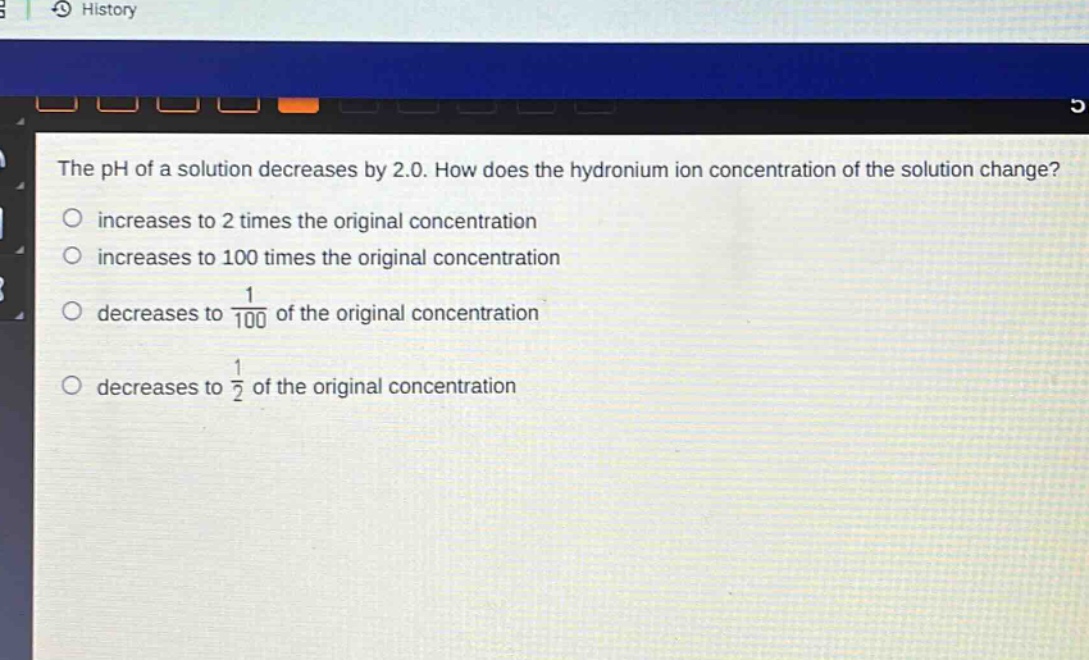
the ph of a solution decreases by 2.0. how does the hydronium ion concentration of the solution change?\n increases to 2 times the original concentration\n increases to 100 times the original concentration\n decreases to $\frac{1}{100}$ of the original concentration\n decreases to $\frac{1}{2}$ of the original concentration
Answer
Explanation:
Step1: Recall pH formula
The pH is defined as $pH = -\log[H_3O^+]$, where $[H_3O^+]$ is the hydronium - ion concentration. Let the initial pH be $pH_1=-\log[H_3O^+]_1$ and the final pH be $pH_2 = -\log[H_3O^+]_2$.
Step2: Use the change in pH
We know that $pH_1 - pH_2=2.0$. Substituting the pH formula, we get $(-\log[H_3O^+]_1)-(-\log[H_3O^+]_2) = 2.0$.
Step3: Simplify the logarithmic equation
Using the property of logarithms $\log a-\log b=\log\frac{a}{b}$, the equation becomes $\log\frac{[H_3O^+]_2}{[H_3O^+]_1}=2.0$.
Step4: Solve for the ratio of concentrations
By the definition of logarithms, if $\log x = y$, then $x = 10^y$. So, $\frac{[H_3O^+]_2}{[H_3O^+]_1}=10^{2.0}=100$. This means $[H_3O^+]_2 = 100\times[H_3O^+]_1$.
Answer:
increases to 100 times the original concentration