polar water molecules are attracted to other polar water molecules. a slightly positive hydrogen atom in one…
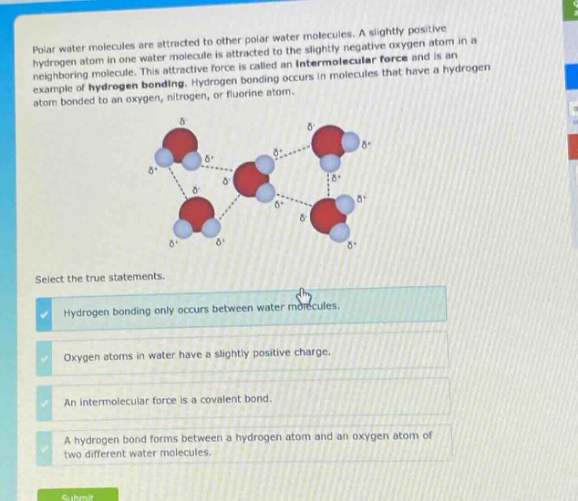
polar water molecules are attracted to other polar water molecules. a slightly positive hydrogen atom in one water - molecule is attracted to the slightly negative oxygen atom in a neighboring molecule. this attractive force is called an intermolecular force and is an example of hydrogen bonding. hydrogen bonding occurs in molecules that have a hydrogen atom bonded to an oxygen, nitrogen, or fluorine atom. select the true statements. hydrogen bonding only occurs between water molecules. oxygen atoms in water have a slightly positive charge. an intermolecular force is a covalent bond. a hydrogen bond forms between a hydrogen atom and an oxygen atom of two different water molecules.
Answer
Answer:
A hydrogen bond forms between a hydrogen atom and an oxygen atom of two different water molecules.
Explanation:
Step1: Analyze hydrogen - bonding statement
Hydrogen bonding occurs in molecules with H bonded to O, N, or F, not just water. So "Hydrogen bonding only occurs between water molecules." is false.
Step2: Analyze oxygen charge in water
Oxygen is more electronegative than hydrogen in water, so oxygen has a slightly negative charge, not positive. So "Oxygen atoms in water have a slightly positive charge." is false.
Step3: Analyze intermolecular force type
An intermolecular force is an attraction between different molecules, while a covalent bond is an intramolecular force (within a molecule). So "An intermolecular force is a covalent bond." is false.
Step4: Analyze hydrogen - bond formation
In water, a hydrogen bond indeed forms between a hydrogen atom of one water molecule and an oxygen atom of another water molecule. This statement is true.