practice: stoichiometry\nshow all work for each problem below.\n1. how many moles of sodium sulfate will be…
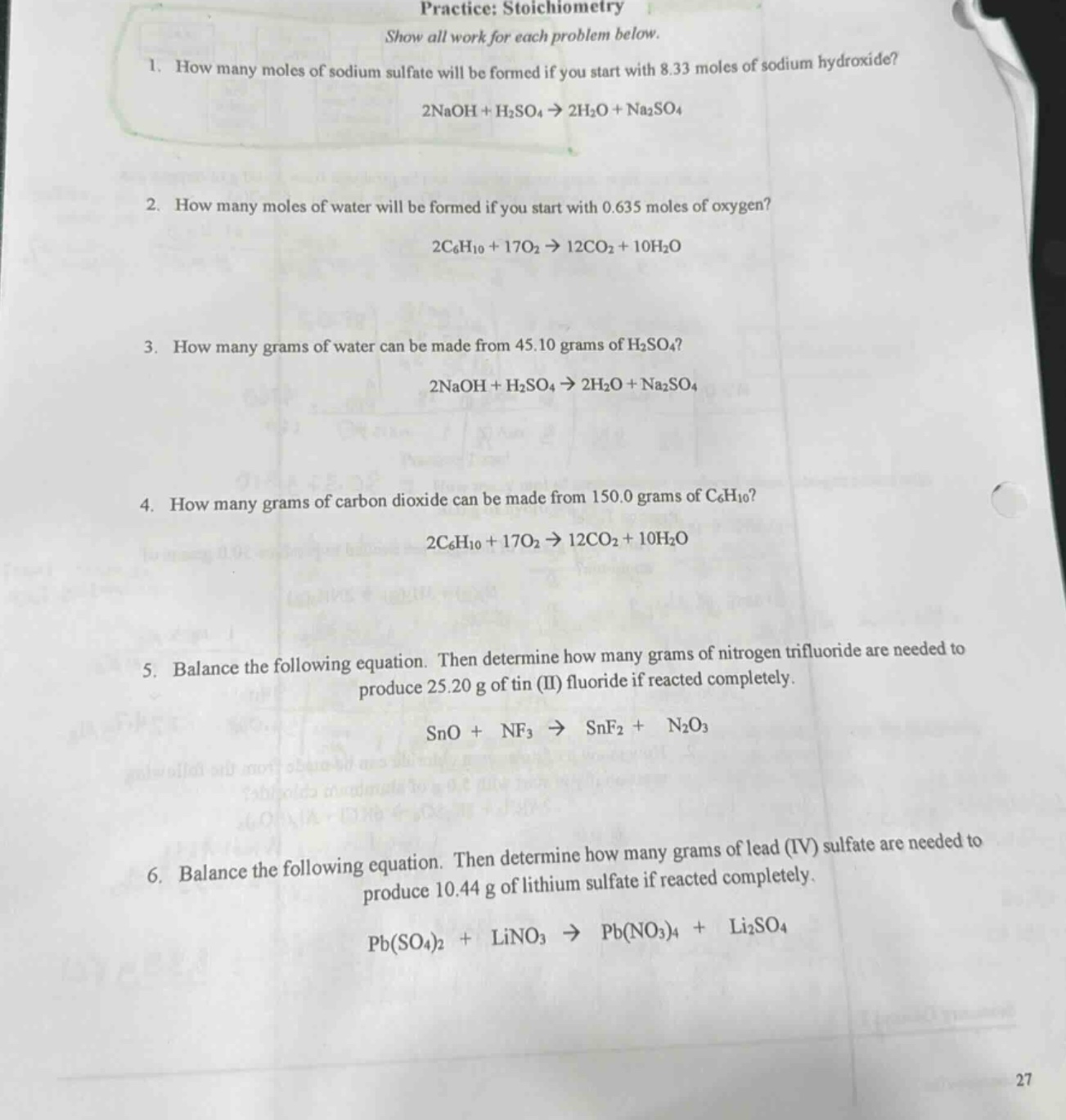
practice: stoichiometry\nshow all work for each problem below.\n1. how many moles of sodium sulfate will be formed if you start with 8.33 moles of sodium hydroxide?\n2naoh + h2so4 → 2h2o + na2so4\n2. how many moles of water will be formed if you start with 0.635 moles of oxygen?\n2c6h10 + 17o2 → 12co2 + 10h2o\n3. how many grams of water can be made from 45.10 grams of h2so4?\n2naoh + h2so4 → 2h2o + na2so4\n4. how many grams of carbon dioxide can be made from 150.0 grams of c6h10?\n2c6h10 + 17o2 → 12co2 + 10h2o\n5. balance the following equation. then determine how many grams of nitrogen trifluoride are needed to produce 25.20 g of tin (ii) fluoride if reacted completely.\nsno + nf3 → snf2 + n2o3\n6. balance the following equation. then determine how many grams of lead (iv) sulfate are needed to produce 10.44 g of lithium sulfate if reacted completely.\npb(so4)2 + lino3 → pb(no3)4 + li2so4
Answer
Explanation:
Step1: Identify mole - ratio for question 1
From the equation $2NaOH + H_2SO_4\rightarrow2H_2O + Na_2SO_4$, the mole - ratio of $NaOH$ to $Na_2SO_4$ is $2:1$.
Step2: Calculate moles of $Na_2SO_4$ for question 1
Let $n_{Na_2SO_4}$ be the moles of sodium sulfate and $n_{NaOH}=8.33$ moles. Using the mole - ratio, $n_{Na_2SO_4}=\frac{n_{NaOH}}{2}=\frac{8.33}{2}=4.165$ moles.
Step3: Identify mole - ratio for question 2
From the equation $2C_6H_{10}+17O_2\rightarrow12CO_2 + 10H_2O$, the mole - ratio of $O_2$ to $H_2O$ is $17:10$.
Step4: Calculate moles of $H_2O$ for question 2
Let $n_{H_2O}$ be the moles of water and $n_{O_2} = 0.635$ moles. Then $n_{H_2O}=\frac{10}{17}n_{O_2}=\frac{10}{17}\times0.635\approx0.374$ moles.
Step5: Calculate moles of $H_2SO_4$ for question 3
The molar mass of $H_2SO_4$ is $M_{H_2SO_4}=2\times1 + 32+4\times16=98$ g/mol. Given $m_{H_2SO_4}=45.10$ g, the moles of $H_2SO_4$, $n_{H_2SO_4}=\frac{m_{H_2SO_4}}{M_{H_2SO_4}}=\frac{45.10}{98}\approx0.46$ moles.
Step6: Identify mole - ratio and calculate moles of $H_2O$ for question 3
From the equation $2NaOH + H_2SO_4\rightarrow2H_2O + Na_2SO_4$, the mole - ratio of $H_2SO_4$ to $H_2O$ is $1:2$. So $n_{H_2O}=2n_{H_2SO_4}=2\times0.46 = 0.92$ moles.
Step7: Calculate mass of $H_2O$ for question 3
The molar mass of $H_2O$ is $M_{H_2O}=2\times1+16 = 18$ g/mol. So $m_{H_2O}=n_{H_2O}\times M_{H_2O}=0.92\times18 = 16.56$ g.
Step8: Calculate moles of $C_6H_{10}$ for question 4
The molar mass of $C_6H_{10}$ is $M_{C_6H_{10}}=6\times12 + 10\times1=82$ g/mol. Given $m_{C_6H_{10}}=150.0$ g, $n_{C_6H_{10}}=\frac{m_{C_6H_{10}}}{M_{C_6H_{10}}}=\frac{150.0}{82}\approx1.83$ moles.
Step9: Identify mole - ratio and calculate moles of $CO_2$ for question 4
From the equation $2C_6H_{10}+17O_2\rightarrow12CO_2 + 10H_2O$, the mole - ratio of $C_6H_{10}$ to $CO_2$ is $2:12 = 1:6$. So $n_{CO_2}=6n_{C_6H_{10}}=6\times1.83 = 10.98$ moles.
Step10: Calculate mass of $CO_2$ for question 4
The molar mass of $CO_2$ is $M_{CO_2}=12 + 2\times16=44$ g/mol. So $m_{CO_2}=n_{CO_2}\times M_{CO_2}=10.98\times44 = 483.12$ g.
Step11: Balance the equation for question 5
The balanced equation is $3SnO+2NF_3\rightarrow3SnF_2 + N_2O_3$.
Step12: Calculate moles of $SnF_2$ for question 5
The molar mass of $SnF_2$ is $M_{SnF_2}=118.7+2\times19 = 156.7$ g/mol. Given $m_{SnF_2}=25.20$ g, $n_{SnF_2}=\frac{m_{SnF_2}}{M_{SnF_2}}=\frac{25.20}{156.7}\approx0.161$ moles.
Step13: Identify mole - ratio and calculate moles of $NF_3$ for question 5
From the balanced equation, the mole - ratio of $NF_3$ to $SnF_2$ is $2:3$. So $n_{NF_3}=\frac{2}{3}n_{SnF_2}=\frac{2}{3}\times0.161\approx0.107$ moles.
Step14: Calculate mass of $NF_3$ for question 5
The molar mass of $NF_3$ is $M_{NF_3}=14+3\times19 = 71$ g/mol. So $m_{NF_3}=n_{NF_3}\times M_{NF_3}=0.107\times71 = 7.597$ g.
Step15: Balance the equation for question 6
The balanced equation is $Pb(SO_4)_2+4LiNO_3\rightarrow Pb(NO_3)_4 + 2Li_2SO_4$.
Step16: Calculate moles of $Li_2SO_4$ for question 6
The molar mass of $Li_2SO_4$ is $M_{Li_2SO_4}=2\times6.94+32 + 4\times16=109.94$ g/mol. Given $m_{Li_2SO_4}=10.44$ g, $n_{Li_2SO_4}=\frac{m_{Li_2SO_4}}{M_{Li_2SO_4}}=\frac{10.44}{109.94}\approx0.095$ moles.
Step17: Identify mole - ratio and calculate moles of $Pb(SO_4)_2$ for question 6
From the balanced equation, the mole - ratio of $Pb(SO_4)2$ to $Li_2SO_4$ is $1:2$. So $n{Pb(SO_4)2}=\frac{1}{2}n{Li_2SO_4}=\frac{1}{2}\times0.095 = 0.0475$ moles.
Step18: Calculate mass of $Pb(SO_4)_2$ for question 6
The molar mass of $Pb(SO_4)2$ is $M{Pb(SO_4)2}=207.2+(32 + 4\times16)\times2=399.3$ g/mol. So $m{Pb(SO_4)2}=n{Pb(SO_4)2}\times M{Pb(SO_4)_2}=0.0475\times399.3\approx18.97$ g.
Answer:
- $4.165$ moles
- $0.374$ moles
- $16.56$ g
- $483.12$ g
- Balanced equation: $3SnO + 2NF_3\rightarrow3SnF_2+N_2O_3$, $7.597$ g of $NF_3$
- Balanced equation: $Pb(SO_4)_2 + 4LiNO_3\rightarrow Pb(NO_3)_4+2Li_2SO_4$, $18.97$ g of $Pb(SO_4)_2$