predicting reaction products\npredict the products for the following reactions, balance the equation, then…
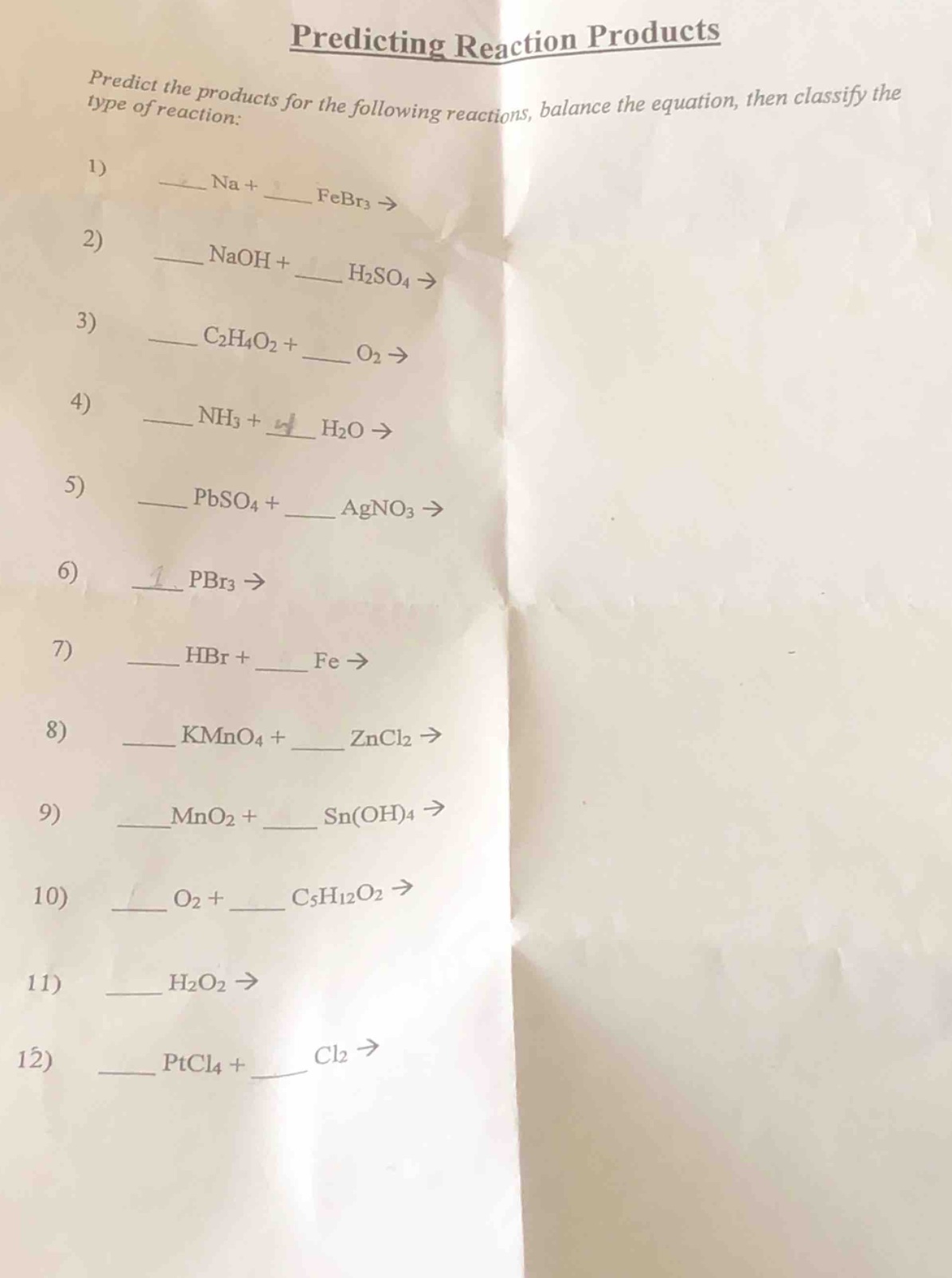
predicting reaction products\npredict the products for the following reactions, balance the equation, then classify the type of reaction:\n1) ___ na + ___ febr₃ →\n2) ___ naoh + ___ h₂so₄ →\n3) ___ c₂h₄o₂ + ___ o₂ →\n4) ___ nh₃ + ___ h₂o →\n5) ___ pbso₄ + ___ agno₃ →\n6) ___ pbr₃ →\n7) ___ hbr + ___ fe →\n8) ___ kmno₄ + ___ zncl₂ →\n9) ___ mno₂ + ___ sn(oh)₄ →\n10) ___ o₂ + ___ c₅h₁₂o₂ →\n11) ___ h₂o₂ →\n12) ___ ptcl₄ + ___ cl₂ →
Answer
Explanation:
Step1: Predict products for 1)
Sodium (Na) will displace iron in iron(III) bromide ($FeBr_3$) to form sodium bromide ($NaBr$) and iron (Fe). The un - balanced equation is $Na+FeBr_3\rightarrow NaBr + Fe$. To balance, we need 3 moles of Na to react with 1 mole of $FeBr_3$ to get 3 moles of $NaBr$ and 1 mole of Fe. The balanced equation is $3Na+FeBr_3\rightarrow 3NaBr + Fe$. This is a single - replacement reaction.
Step2: Predict products for 2)
Sodium hydroxide ($NaOH$) and sulfuric acid ($H_2SO_4$) react in a neutralization reaction to form sodium sulfate ($Na_2SO_4$) and water ($H_2O$). The un - balanced equation is $NaOH + H_2SO_4\rightarrow Na_2SO_4+H_2O$. To balance, we need 2 moles of $NaOH$ to react with 1 mole of $H_2SO_4$ to get 1 mole of $Na_2SO_4$ and 2 moles of $H_2O$. The balanced equation is $2NaOH + H_2SO_4\rightarrow Na_2SO_4 + 2H_2O$. This is a double - replacement (neutralization) reaction.
Step3: Predict products for 3)
Ethanoic acid ($C_2H_4O_2$) undergoes combustion in the presence of oxygen ($O_2$) to form carbon dioxide ($CO_2$) and water ($H_2O$). The un - balanced equation is $C_2H_4O_2+O_2\rightarrow CO_2 + H_2O$. To balance, we have $C_2H_4O_2+2O_2\rightarrow 2CO_2+2H_2O$. This is a combustion reaction.
Step4: Predict products for 4)
Ammonia ($NH_3$) reacts with water ($H_2O$) to form ammonium hydroxide ($NH_4OH$). The balanced equation is $NH_3 + H_2O\rightarrow NH_4OH$. This is a combination reaction.
Step5: Predict products for 5)
Lead(II) sulfate ($PbSO_4$) and silver nitrate ($AgNO_3$) react in a double - replacement reaction to form lead(II) nitrate ($Pb(NO_3)_2$) and silver sulfate ($Ag_2SO_4$). The un - balanced equation is $PbSO_4+AgNO_3\rightarrow Pb(NO_3)_2+Ag_2SO_4$. To balance, we need 2 moles of $AgNO_3$. The balanced equation is $PbSO_4 + 2AgNO_3\rightarrow Pb(NO_3)_2+Ag_2SO_4$.
Step6: Predict products for 6)
Phosphorus tribromide ($PBr_3$) decomposes into phosphorus (P) and bromine ($Br_2$). The un - balanced equation is $PBr_3\rightarrow P+Br_2$. To balance, we need 2 moles of $PBr_3$ to get 2 moles of P and 3 moles of $Br_2$. The balanced equation is $2PBr_3\rightarrow 2P + 3Br_2$. This is a decomposition reaction.
Step7: Predict products for 7)
Hydrobromic acid ($HBr$) reacts with iron (Fe) in a single - replacement reaction to form iron(II) bromide ($FeBr_2$) and hydrogen gas ($H_2$). The un - balanced equation is $HBr+Fe\rightarrow FeBr_2+H_2$. To balance, we need 2 moles of $HBr$. The balanced equation is $2HBr+Fe\rightarrow FeBr_2 + H_2$.
Step8: Predict products for 8)
Potassium permanganate ($KMnO_4$) and zinc chloride ($ZnCl_2$) do not react as there is no driving force such as formation of a precipitate, gas or water. So, no reaction.
Step9: Predict products for 9)
Manganese(IV) oxide ($MnO_2$) and tin(IV) hydroxide ($Sn(OH)_4$) do not react under normal conditions as there is no suitable reaction mechanism for a simple exchange or other common reaction types. So, no reaction.
Step10: Predict products for 10)
$C_5H_{12}O_2$ undergoes combustion in the presence of oxygen ($O_2$) to form carbon dioxide ($CO_2$) and water ($H_2O$). The un - balanced equation is $C_5H_{12}O_2+O_2\rightarrow CO_2+H_2O$. To balance, we have $C_5H_{12}O_2+7O_2\rightarrow 5CO_2 + 6H_2O$. This is a combustion reaction.
Step11: Predict products for 11)
Hydrogen peroxide ($H_2O_2$) decomposes into water ($H_2O$) and oxygen gas ($O_2$). The un - balanced equation is $H_2O_2\rightarrow H_2O+O_2$. To balance, we need 2 moles of $H_2O_2$ to get 2 moles of $H_2O$ and 1 mole of $O_2$. The balanced equation is $2H_2O_2\rightarrow 2H_2O+O_2$. This is a decomposition reaction.
Step12: Predict products for 12)
Platinum(IV) chloride ($PtCl_4$) and chlorine gas ($Cl_2$) may react to form platinum(VI) chloride ($PtCl_6$). The balanced equation is $PtCl_4+Cl_2\rightarrow PtCl_6$. This is a combination reaction.
Answer:
- $3Na+FeBr_3\rightarrow 3NaBr + Fe$, single - replacement
- $2NaOH + H_2SO_4\rightarrow Na_2SO_4 + 2H_2O$, double - replacement (neutralization)
- $C_2H_4O_2+2O_2\rightarrow 2CO_2+2H_2O$, combustion
- $NH_3 + H_2O\rightarrow NH_4OH$, combination
- $PbSO_4 + 2AgNO_3\rightarrow Pb(NO_3)_2+Ag_2SO_4$, double - replacement
- $2PBr_3\rightarrow 2P + 3Br_2$, decomposition
- $2HBr+Fe\rightarrow FeBr_2 + H_2$, single - replacement
- No reaction
- No reaction
- $C_5H_{12}O_2+7O_2\rightarrow 5CO_2 + 6H_2O$, combustion
- $2H_2O_2\rightarrow 2H_2O+O_2$, decomposition
- $PtCl_4+Cl_2\rightarrow PtCl_6$, combination