problem 4.60. a 750 ml vessel contains 2.50 g of an unknown gas at a temperature of 0° c and a pressure of…
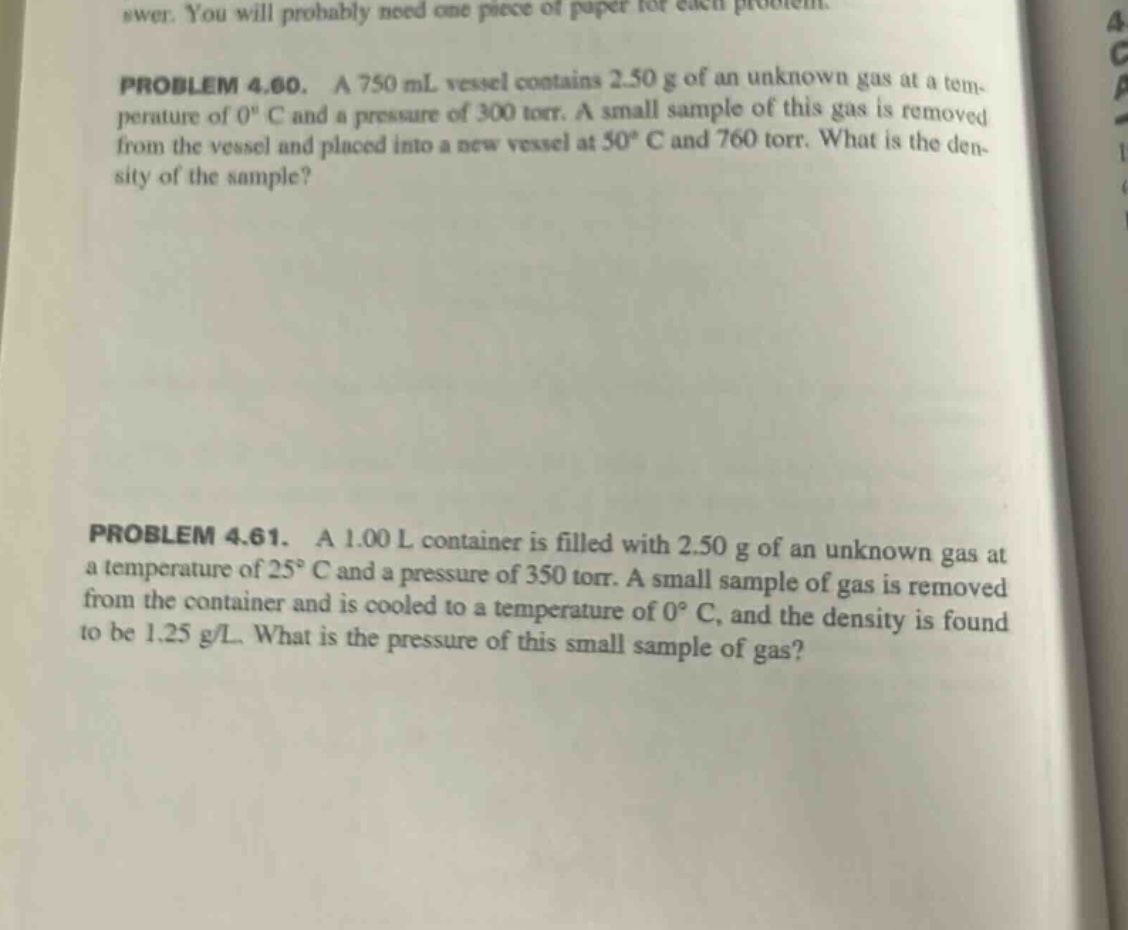
problem 4.60. a 750 ml vessel contains 2.50 g of an unknown gas at a temperature of 0° c and a pressure of 300 torr. a small sample of this gas is removed from the vessel and placed into a new vessel at 50° c and 760 torr. what is the density of the sample? problem 4.61. a 1.00 l container is filled with 2.50 g of an unknown gas at a temperature of 25° c and a pressure of 350 torr. a small sample of gas is removed from the container and is cooled to a temperature of 0° c, and the density is found to be 1.25 g/l. what is the pressure of this small sample of gas?
Answer
Explanation:
Step1: Convert units
First, convert the initial volume to liters ($V_1 = 750\ mL=0.75\ L$), temperatures to Kelvin ($T_1 = 0^{\circ}C + 273 = 273\ K$, $T_2=50^{\circ}C + 273=323\ K$), and pressures to atmospheres ($P_1=\frac{300}{760}\ atm$, $P_2 = 1\ atm$). The mass of the gas $m = 2.50\ g$.
Step2: Use the ideal - gas law $PV=nRT$ to find the number of moles $n$ in the initial state
$n=\frac{P_1V_1}{RT_1}$, where $R = 0.0821\ L\cdot atm/(mol\cdot K)$. Substitute $P_1=\frac{300}{760}\ atm$, $V_1 = 0.75\ L$, $T_1 = 273\ K$ and $R = 0.0821\ L\cdot atm/(mol\cdot K)$ into the formula: $n=\frac{\frac{300}{760}\ atm\times0.75\ L}{0.0821\ L\cdot atm/(mol\cdot K)\times273\ K}$
Step3: Since the amount of gas (number of moles) is conserved when a small sample is taken out
We can use the ideal - gas law in the new state $P_2V_2=nRT_2$ to find the volume $V_2$ of the sample in the new state. Rearranging for $V_2$ gives $V_2=\frac{nRT_2}{P_2}$.
Step4: Calculate the density $\rho$
Density $\rho=\frac{m}{V_2}$. Since the mass of the sample is proportional to the number of moles and the mass of the whole gas is $m = 2.50\ g$, and we know the relationship between the states from the ideal - gas law. A more straightforward way is to use the combined gas law $\frac{P_1V_1}{T_1}=\frac{P_2V_2}{T_2}$ to find the volume change and then calculate the density. First, from $\frac{P_1V_1}{T_1}=\frac{P_2V_2}{T_2}$, we can solve for $V_2$: $V_2=\frac{P_1V_1T_2}{P_2T_1}$ Substitute $P_1 = 300\ torr$, $V_1 = 750\ mL$, $T_1 = 273\ K$, $P_2 = 760\ torr$, $T_2 = 323\ K$ $V_2=\frac{300\ torr\times750\ mL\times323\ K}{760\ torr\times273\ K}$ $V_2=\frac{300\times750\times323}{760\times273}\ mL\approx347.7\ mL = 0.3477\ L$ Density $\rho=\frac{m}{V_2}$, with $m = 2.50\ g$ $\rho=\frac{2.50\ g}{0.3477\ L}\approx7.19\ g/L$
Answer:
$7.19\ g/L$