which process or processes produce an increase in entropy?\ni. n₂(g) + 3h₂(g) → nh₃(g)\nii. c₁₀h₈(g) →…
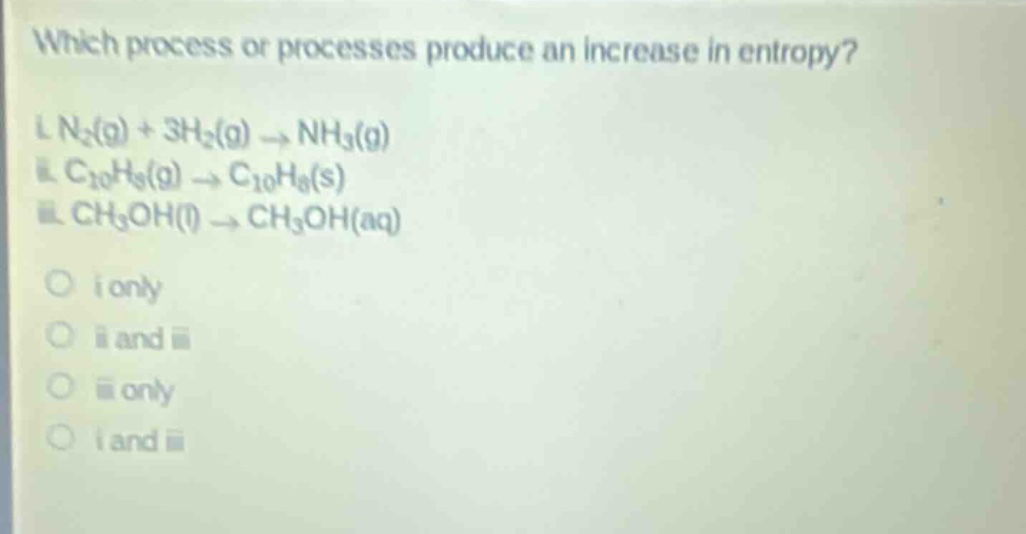
which process or processes produce an increase in entropy?\ni. n₂(g) + 3h₂(g) → nh₃(g)\nii. c₁₀h₈(g) → c₁₀h₈(s)\niii. ch₃oh(l) → ch₃oh(aq)\no i only\no ii and iii\no iii only\no i and iii
Answer
Brief Explanations:
Entropy is a measure of disorder. Gases have higher entropy than liquids and solids. In process I, the number of moles of gas decreases, so entropy decreases. In process II, a gas is changing to a solid, so entropy decreases. In process III, a liquid is becoming an aqueous solution where particles are more spread out and disordered, so entropy increases.
Answer:
C. ⅲ only