a) prove that the total energy required to break the bonds in 1 mol of ch4 and 2 mol of oxygen is 2644…
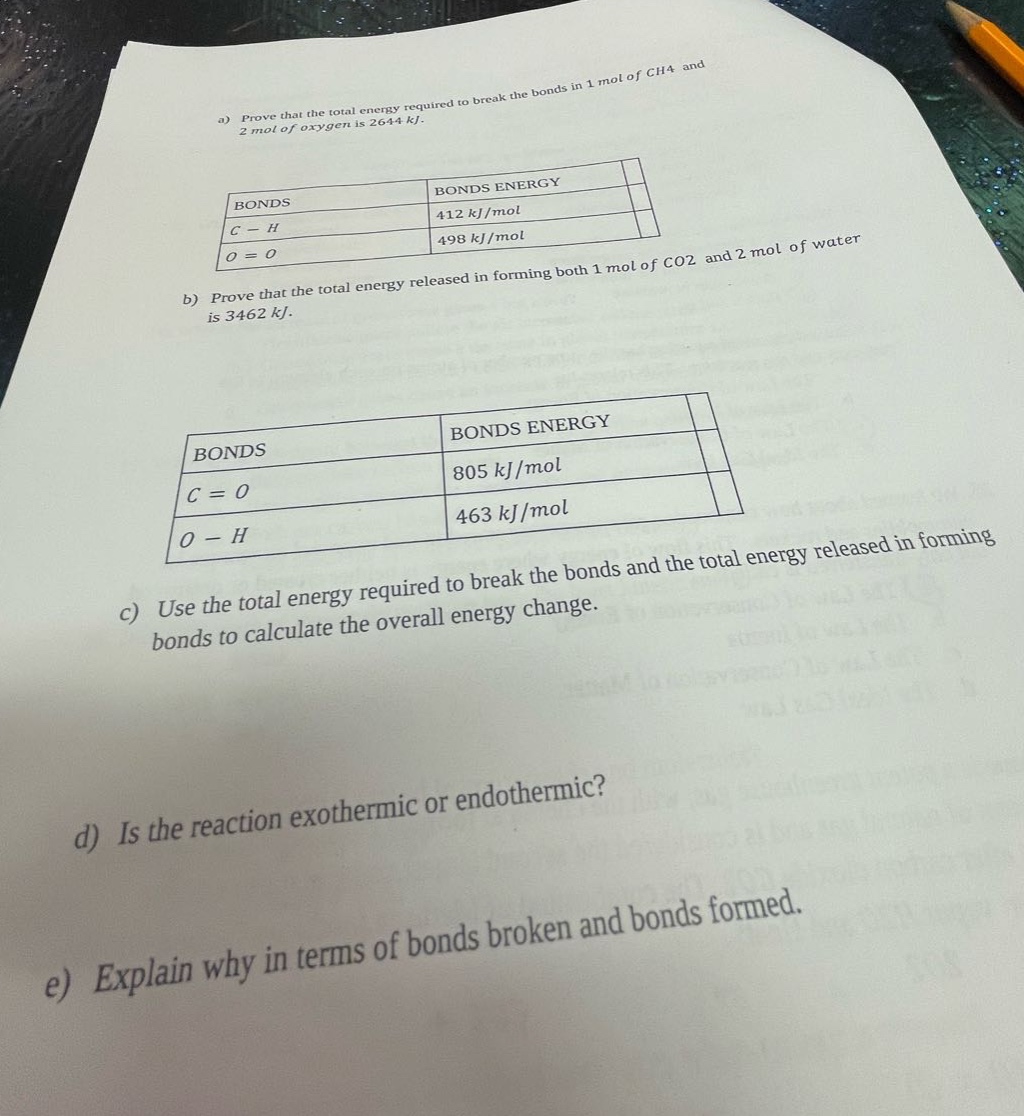
a) prove that the total energy required to break the bonds in 1 mol of ch4 and 2 mol of oxygen is 2644 kj.\nbonds bonds energy\nc - h 412 kj/mol\no = o 498 kj/mol\nb) prove that the total energy released in forming both 1 mol of co2 and 2 mol of water is 3462 kj.\nbonds bonds energy\nc = o 805 kj/mol\no - h 463 kj/mol\nc) use the total energy required to break the bonds and the total energy released in forming bonds to calculate the overall energy change.\nd) is the reaction exothermic or endothermic?\ne) explain why in terms of bonds broken and bonds formed.
Answer
Explanation:
Step1: Calculate energy to break bonds in part a
In $CH_4$, there are 4 $C - H$ bonds. Energy to break $CH_4$ is $4\times412\ kJ$. In 2 mol of $O_2$, there are 2 $O = O$ bonds. Energy to break $O_2$ is $2\times498\ kJ$. Total energy to break bonds $E_{break}=4\times412 + 2\times498=1648+996 = 2644\ kJ$.
Step2: Calculate energy released in bond - formation in part b
In 1 mol of $CO_2$, there are 2 $C = O$ bonds. Energy released in forming $CO_2$ is $2\times805\ kJ$. In 2 mol of $H_2O$, there are 4 $O - H$ bonds. Energy released in forming $H_2O$ is $4\times463\ kJ$. Total energy released in forming bonds $E_{form}=2\times805+4\times463 = 1610 + 1852=3462\ kJ$.
Step3: Calculate overall energy change in part c
Overall energy change $\Delta E=E_{break}-E_{form}=2644 - 3462=- 818\ kJ$.
Step4: Determine reaction type in part d
Since $\Delta E=-818\ kJ<0$, the reaction is exothermic.
Step5: Explain reaction type in part e
More energy is released when new bonds are formed ($3462\ kJ$) than the energy required to break the original bonds ($2644\ kJ$), so the reaction is exothermic.
Answer:
a) Proven as above. b) Proven as above. c) $-818\ kJ$ d) Exothermic e) More energy is released in bond - formation than energy required for bond - breaking.