pure water at 25°c\n○ ionizes in the presence of acid to form an equilibrium in which h₃o⁺=oh⁻=10⁷m.\n○…
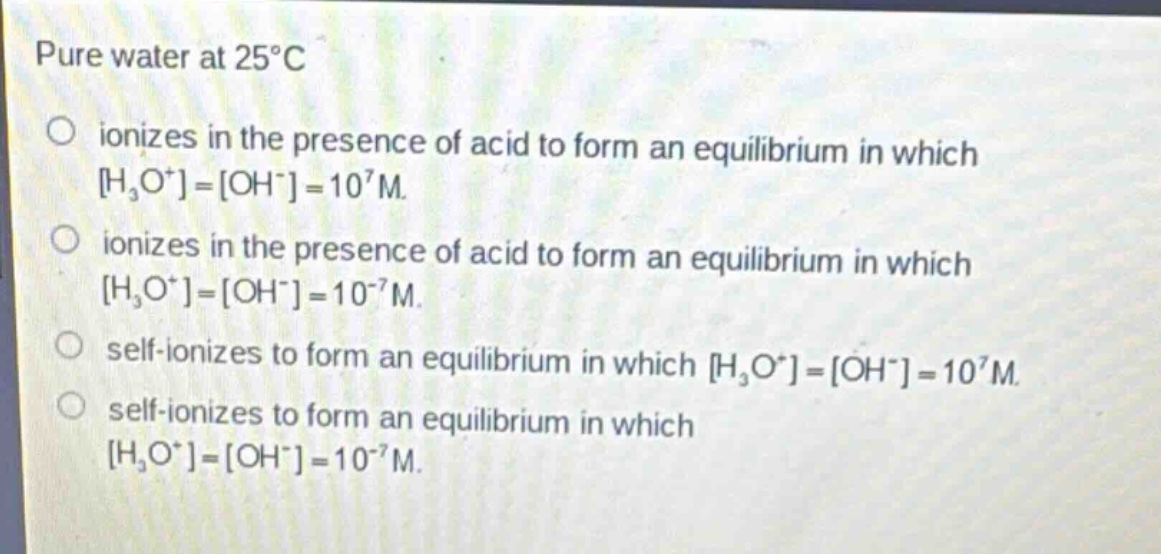
pure water at 25°c\n○ ionizes in the presence of acid to form an equilibrium in which h₃o⁺=oh⁻=10⁷m.\n○ ionizes in the presence of acid to form an equilibrium in which h₃o⁺=oh⁻=10⁻⁷m.\n○ self - ionizes to form an equilibrium in which h₃o⁺=oh⁻=10⁷m.\n○ self - ionizes to form an equilibrium in which h₃o⁺=oh⁻=10⁻⁷m.
Answer
Brief Explanations:
Pure water at 25°C undergoes self - ionization. The auto - ionization of water gives an equilibrium where the concentration of hydronium ions $[H_3O^+]$ is equal to the concentration of hydroxide ions $[OH^-]$, and at 25°C, $[H_3O^+]=[OH^-]=10^{-7}\ M$. It is not about ionization in the presence of acid for this basic property of pure water, and the correct concentration values are $10^{-7}\ M$ not $10^{7}\ M$.
Answer:
The statement "self - ionizes to form an equilibrium in which $[H_3O^+]=[OH^-]=10^{-7}\ M$" is correct.