question 7 of 10 how can the effect of heat on a reaction be determined? a. heat always shifts a reaction…
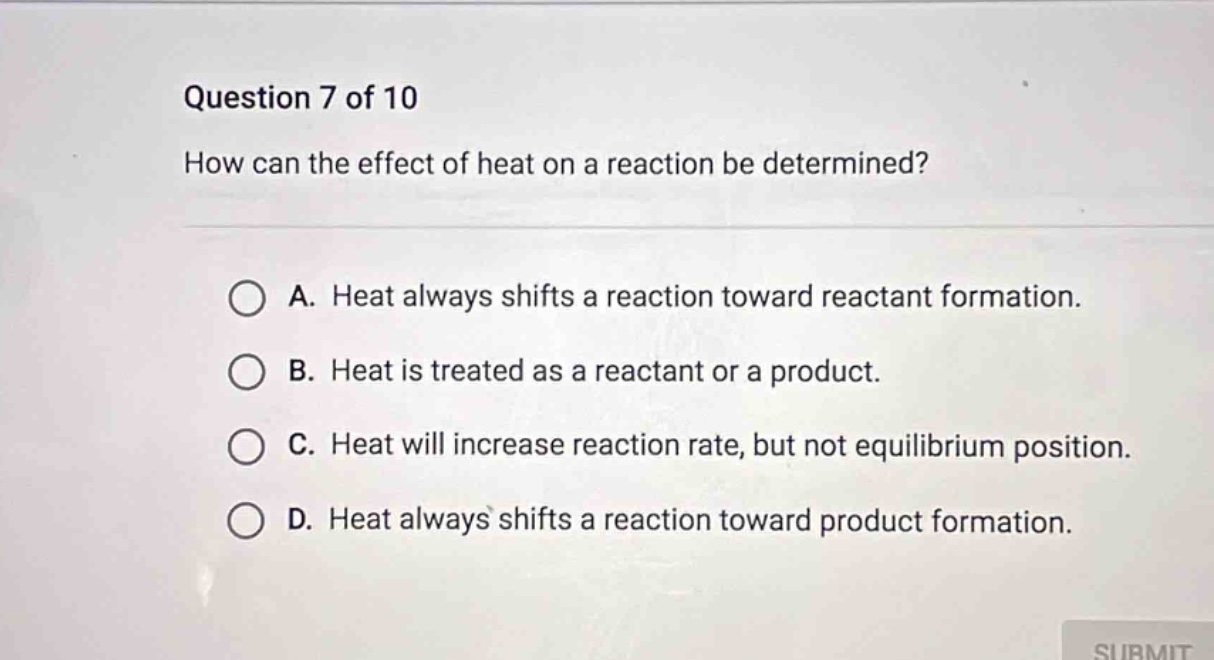
question 7 of 10 how can the effect of heat on a reaction be determined? a. heat always shifts a reaction toward reactant formation. b. heat is treated as a reactant or a product. c. heat will increase reaction rate, but not equilibrium position. d. heat always shifts a reaction toward product formation.
Answer
Answer:
B. Heat is treated as a reactant or a product.
Brief Explanations:
According to Le - Chatelier's principle, in a chemical reaction at equilibrium, heat can be considered as a reactant in endothermic reactions or a product in exothermic reactions to predict the shift in equilibrium when temperature changes.