question 8 of 10\nwhy do nonpolar compounds tend to have lower melting points and boiling\npoints than polar…
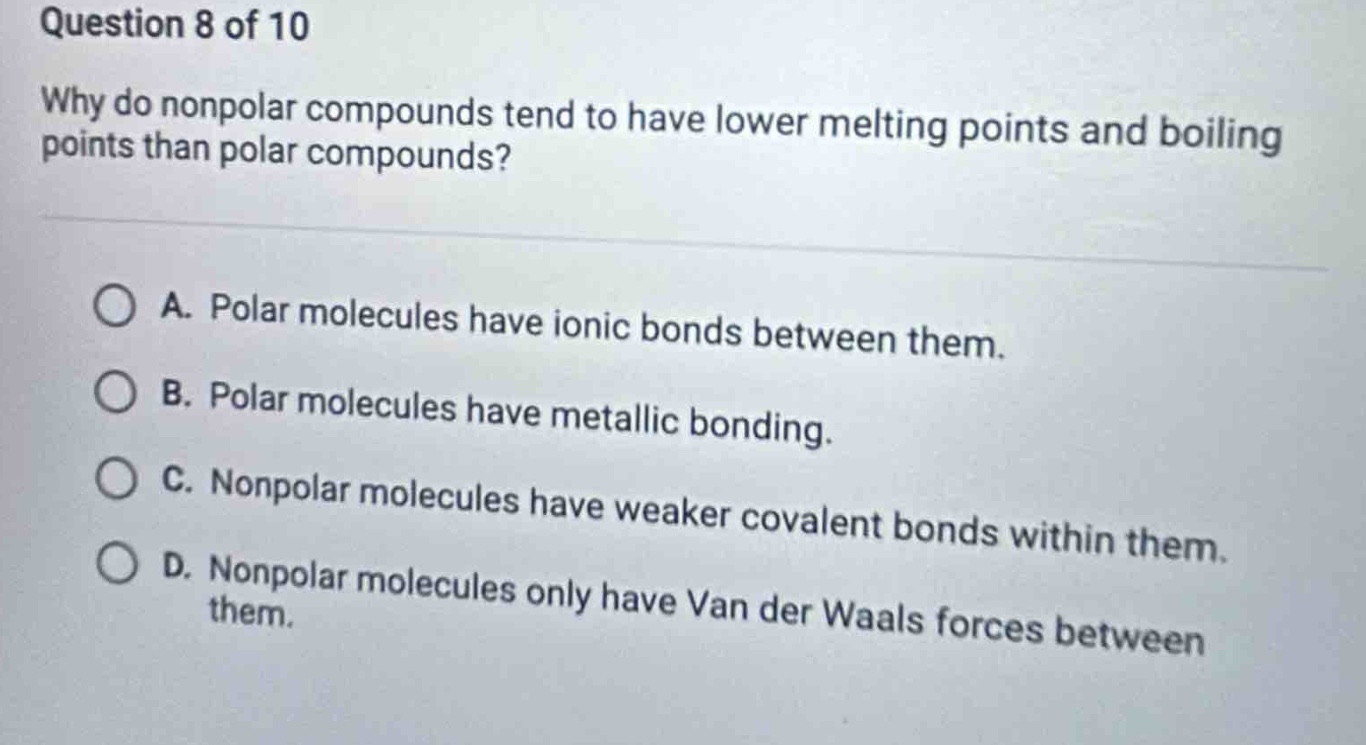
question 8 of 10\nwhy do nonpolar compounds tend to have lower melting points and boiling\npoints than polar compounds?\na. polar molecules have ionic bonds between them.\nb. polar molecules have metallic bonding.\nc. nonpolar molecules have weaker covalent bonds within them.\nd. nonpolar molecules only have van der waals forces between them.
Answer
Brief Explanations:
- Option A: Polar molecules do not have ionic bonds between them. Ionic bonds are between ions (e.g., in ionic compounds like NaCl), not between polar molecules. Polar molecules have dipole - dipole interactions.
- Option B: Polar molecules do not have metallic bonding. Metallic bonding occurs in metals (a lattice of metal cations surrounded by a sea of delocalized electrons).
- Option C: The covalent bonds within non - polar molecules (e.g., (H_2) has a (H - H) covalent bond) are not necessarily weaker. For example, the (C - C) covalent bond in non - polar alkanes can be quite strong. The melting and boiling points are related to the intermolecular forces, not the intramolecular covalent bonds.
- Option D: Non - polar molecules have only Van der Waals (London dispersion) forces between them. Van der Waals forces are the weakest of the intermolecular forces (compared to dipole - dipole forces in polar molecules and hydrogen bonds in some polar molecules like (H_2O)). Since melting and boiling involve overcoming intermolecular forces, weaker intermolecular forces (Van der Waals in non - polar molecules) result in lower melting and boiling points.
Answer:
D. Nonpolar molecules only have Van der Waals forces between them.