question 11: how can you use the simulator to change the concentration of a solution? experiment: using the…
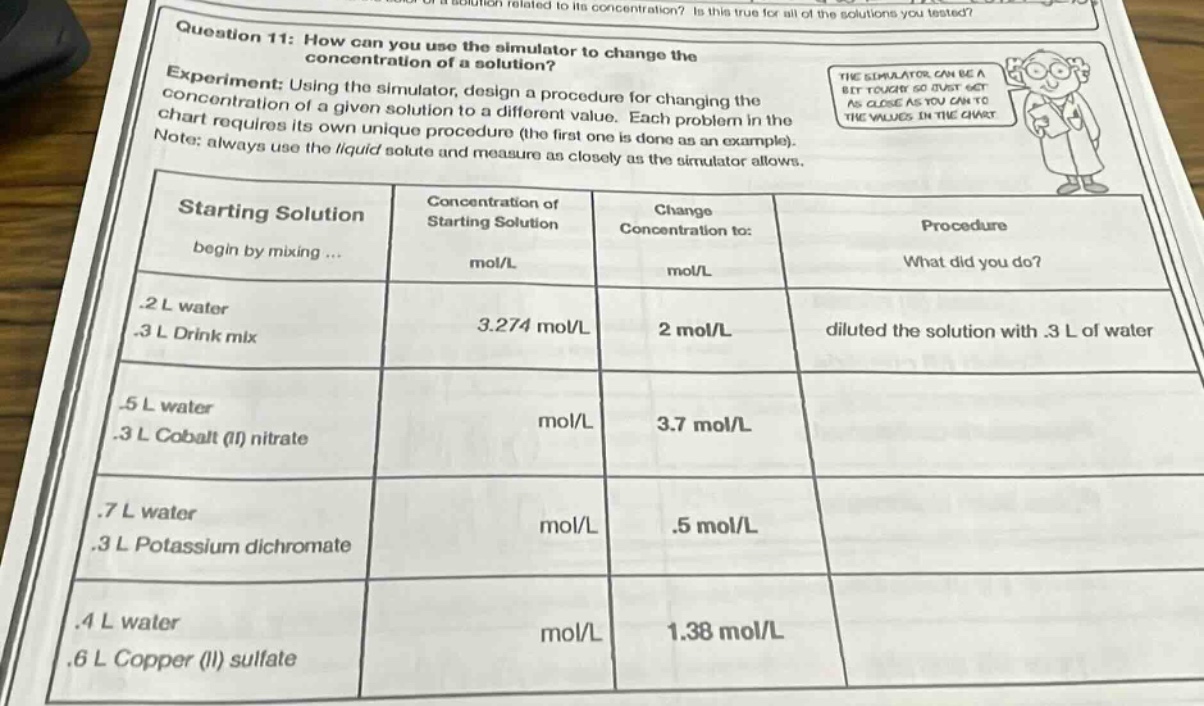
question 11: how can you use the simulator to change the concentration of a solution? experiment: using the simulator, design a procedure for changing the concentration of a given solution to a different value. each problem in the chart requires its own unique procedure (the first one is done as an example). note: always use the liquid solute and measure as closely as the simulator allows. starting solution begin by mixing ... concentration of starting solution mol/l change concentration to: mol/l procedure what did you do? .2 l water .3 l drink mix 3.274 mol/l 2 mol/l diluted the solution with .3 l of water .5 l water .3 l cobalt (ii) nitrate mol/l 3.7 mol/l .7 l water .3 l potassium dichromate mol/l .5 mol/l .4 l water .6 l copper (ii) sulfate mol/l 1.38 mol/l
Answer
Explanation:
Step1: Recall dilution - concentration formula
The formula for dilution is $C_1V_1 = C_2V_2$, where $C_1$ is the initial concentration, $V_1$ is the initial volume, $C_2$ is the final concentration and $V_2$ is the final volume. First, find the initial number of moles $n = C_1V_1$.
Step2: For the second row
Initial volume $V_1=0.5 + 0.3=0.8$ L. Let the initial concentration be $C_1$. We know from $C_1V_1 = C_2V_2$. We want $C_2 = 3.7$ mol/L. First, find the number of moles of cobalt (II) nitrate. Assume we add $x$ L of water. The new volume $V_2=(0.8 + x)$ L. The number of moles of cobalt (II) nitrate $n = C_1V_1$. Since $n$ is conserved during dilution, $C_1\times0.8=3.7\times(0.8 + x)$. We need to know the initial concentration $C_1$ to solve for $x$. But if we assume we use the dilution - concentration relationship conceptually, we can say: Calculate the number of moles of solute in the starting solution ($n = C_1V_1$, where $V_1$ is the volume of the solute solution). Then, using $C_2=\frac{n}{V_2}$, solve for the new volume $V_2$ needed to reach the target concentration $C_2$. The volume of water to add is $V_2 - V_{initial}$. For the starting solution of $0.7$ L water and $0.3$ L potassium dichromate: Initial volume $V_1 = 0.7+0.3 = 1$ L. Let the initial concentration be $C_1$. We want $C_2 = 0.5$ mol/L. Using $C_1V_1 = C_2V_2$, we first find the number of moles of potassium dichromate $n$. Then $V_2=\frac{n}{C_2}$. The volume of water to add is $V_2 - 1$ L. For the starting solution of $0.4$ L water and $0.6$ L copper (II) sulfate: Initial volume $V_1=0.4 + 0.6=1$ L. Let the initial concentration be $C_1$. We want $C_2 = 1.38$ mol/L. Using $C_1V_1 = C_2V_2$, find the number of moles of copper (II) sulfate $n$. Then $V_2=\frac{n}{C_2}$. The volume of water to add is $V_2 - 1$ L.
For the second row:
- First, find the number of moles of cobalt (II) nitrate in the starting solution. The volume of the starting solution $V_1=0.5 + 0.3=0.8$ L. But we don't know the initial concentration $C_1$. Let's assume we use the dilution formula $C_1V_1 = C_2V_2$. We know $C_2 = 3.7$ mol/L.
- Let the volume of water to add be $x$ L. The new - volume $V_2=(0.8 + x)$ L.
- First, calculate the number of moles of solute in the starting solution. Then, since $n$ (number of moles) is conserved during dilution, we can solve for $x$.
- If we assume we know the initial number of moles $n$ of cobalt (II) nitrate, then $n = C_1\times0.8$. And $n = 3.7\times(0.8 + x)$.
- A possible procedure: Calculate the number of moles of cobalt (II) nitrate in the starting solution. Then, using the formula $C=\frac{n}{V}$, find the total volume of the solution needed to have a concentration of $3.7$ mol/L. Add the appropriate volume of water to reach that total volume. For the third row:
- Initial volume of the solution $V_1=0.7 + 0.3=1$ L.
- We want $C_2 = 0.5$ mol/L. First, find the number of moles of potassium dichromate in the starting solution. Let the initial concentration be $C_1$. The number of moles $n = C_1\times1$.
- Using $C_2=\frac{n}{V_2}$, we get $V_2=\frac{n}{0.5}$. The volume of water to add is $V_2 - 1$ L.
- Procedure: Determine the number of moles of potassium dichromate in the starting solution. Then, based on the target concentration of $0.5$ mol/L, calculate the total volume of the solution required. Add the necessary volume of water to the starting solution to reach the calculated total volume. For the fourth row:
- Initial volume of the solution $V_1=0.4+0.6 = 1$ L.
- We want $C_2 = 1.38$ mol/L. First, find the number of moles of copper (II) sulfate in the starting solution. Let the initial concentration be $C_1$. The number of moles $n = C_1\times1$.
- Using $C_2=\frac{n}{V_2}$, we get $V_2=\frac{n}{1.38}$. The volume of water to add is $V_2 - 1$ L.
- Procedure: Calculate the number of moles of copper (II) sulfate in the starting solution. Then, according to the target concentration of $1.38$ mol/L, find the total volume of the solution needed. Add the required volume of water to the starting solution to achieve the desired concentration.
Answer:
Second row: Calculate moles of cobalt (II) nitrate in starting solution, find required total volume for 3.7 mol/L concentration, add water accordingly. Third row: Determine moles of potassium dichromate, find required total volume for 0.5 mol/L concentration, add water. Fourth row: Calculate moles of copper (II) sulfate, find required total volume for 1.38 mol/L concentration, add water.