question 14 refers to the following diagrams.\ncomparison of an equal mass of liquid water and ice\nkey\n○…
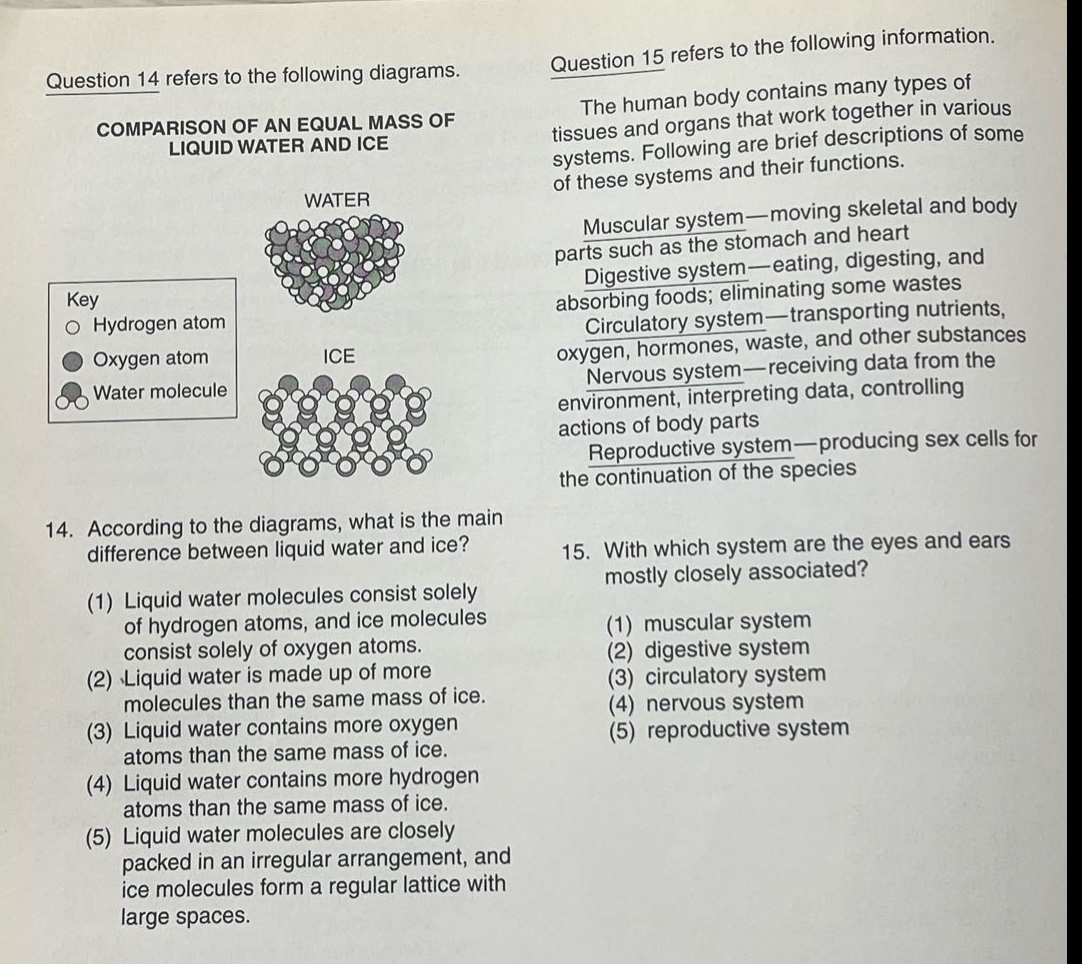
question 14 refers to the following diagrams.\ncomparison of an equal mass of liquid water and ice\nkey\n○ hydrogen atom\n● oxygen atom\nh₂o water molecule\n14. according to the diagrams, what is the main difference between liquid water and ice?\n(1) liquid water molecules consist solely of hydrogen atoms, and ice molecules consist solely of oxygen atoms.\n(2) liquid water is made up of more molecules than the same mass of ice.\n(3) liquid water contains more oxygen atoms than the same mass of ice.\n(4) liquid water contains more hydrogen atoms than the same mass of ice.\n(5) liquid water molecules are closely packed in an irregular arrangement, and ice molecules form a regular lattice with large spaces.\nquestion 15 refers to the following information.\nthe human body contains many types of tissues and organs that work together in various systems. following are brief descriptions of some of these systems and their functions.\nmuscular system—moving skeletal and body parts such as the stomach and heart\ndigestive system—eating, digesting, and absorbing foods; eliminating some wastes\ncirculatory system—transporting nutrients, oxygen, hormones, waste, and other substances\nnervous system—receiving data from the environment, interpreting data, controlling actions of body parts\nreproductive system—producing sex cells for the continuation of the species\n15. with which system are the eyes and ears mostly closely associated?\n(1) muscular system\n(2) digestive system\n(3) circulatory system\n(4) nervous system\n(5) reproductive system
Answer
Brief Explanations:
For question 14, by observing the diagrams, we can see the molecular - level structure difference. Liquid water has closely - packed molecules in an irregular arrangement while ice has a regular lattice with large spaces. For question 15, eyes and ears are sensory organs that receive data from the environment, which is the function of the nervous system.
Answer:
- (5) Liquid water molecules are closely packed in an irregular arrangement, and ice molecules form a regular lattice with large spaces.
- (4) nervous system