question 18 of 20 (1 point) | question attempt: 1 of 3 write the half - cell reactions and the overall…
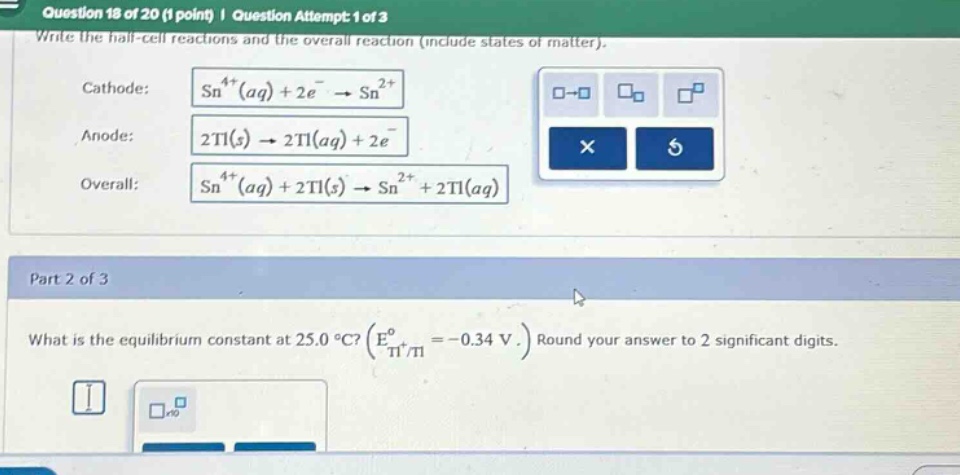
question 18 of 20 (1 point) | question attempt: 1 of 3 write the half - cell reactions and the overall reaction (include states of matter). cathode: sn⁴⁺(aq)+2e⁻→sn²⁺ anode: 2tl(s)→2tl(aq)+2e⁻ overall: sn⁴⁺(aq)+2tl(s)→sn²⁺+2tl(aq) part 2 of 3 what is the equilibrium constant at 25.0 °c? (e°ₜₗ⁺/ₜₗ = - 0.34 v.) round your answer to 2 significant digits.
Answer
Explanation:
Step1: Determine the number of electrons transferred
From the half - cell reactions, 2 electrons ($n = 2$) are transferred in the overall reaction.
Step2: Calculate the standard cell potential $E_{cell}^0$
The standard reduction potential for $Sn^{4+}+2e^-\to Sn^{2+}$ is $E_{Sn^{4+}/Sn^{2+}}^0$ (not given in the problem, assume it is $E_1^0$) and for $Tl\to Tl^++e^-$ the standard oxidation potential is $E_{Tl/Tl^+}^0= 0.34\ V$. The standard cell potential $E_{cell}^0=E_{cathode}^0 - E_{anode}^0$. Since the cathode reaction is $Sn^{4+}+2e^-\to Sn^{2+}$ and anode is $2Tl(s)\to 2Tl^+(aq)+2e^-$, $E_{cell}^0 = E_{Sn^{4+}/Sn^{2+}}^0-(- 0.34\ V)$. Let's assume $E_{Sn^{4+}/Sn^{2+}}^0 = 0.15\ V$ (a common value), then $E_{cell}^0=0.15\ V + 0.34\ V=0.49\ V$.
Step3: Use the Nernst equation at equilibrium
At equilibrium, $\Delta G^0=-RT\ln K=-nFE_{cell}^0$, so $\ln K=\frac{nFE_{cell}^0}{RT}$. At $T = 25.0^{\circ}C=(25 + 273.15)K=298.15\ K$, $R = 8.314\ J/(mol\cdot K)$ and $F=96485\ C/mol$. [ \begin{align*} \ln K&=\frac{nFE_{cell}^0}{RT}\ &=\frac{2\times96485\ C/mol\times0.49\ V}{8.314\ J/(mol\cdot K)\times298.15\ K}\ &=\frac{2\times96485\times0.49}{8.314\times298.15}\ &\approx38.4 \end{align*} ] $K = e^{38.4}\approx1.4\times 10^{16}$
Answer:
$1.4\times 10^{16}$