question 1-22\nthe chemical equation below shows a reaction at equilibrium:\nn₂(g) + 3 h₂(g) ⇌ 2…
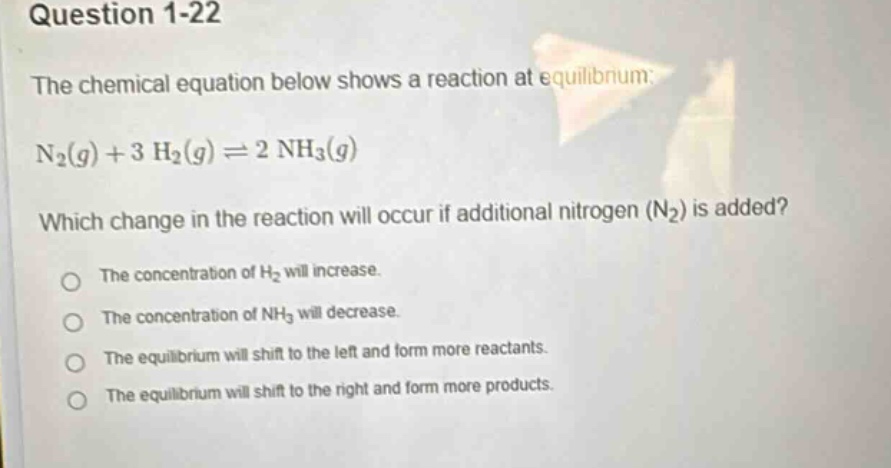
question 1-22\nthe chemical equation below shows a reaction at equilibrium:\nn₂(g) + 3 h₂(g) ⇌ 2 nh₃(g)\nwhich change in the reaction will occur if additional nitrogen (n₂) is added?\nthe concentration of h₂ will increase.\nthe concentration of nh₃ will decrease.\nthe equilibrium will shift to the left and form more reactants.\nthe equilibrium will shift to the right and form more products.
Answer
Answer:
D. The equilibrium will shift to the right and form more products.
Explanation:
Step1: Apply Le - Chatelier's principle
According to Le - Chatelier's principle, when a stress is applied to a system at equilibrium, the system will adjust to relieve the stress.
Step2: Analyze the added substance
Here, additional nitrogen ($N_2$) is added. $N_2$ is a reactant in the reaction $N_2(g)+3H_2(g)\rightleftharpoons 2NH_3(g)$.
Step3: Determine the shift direction
To counteract the increase in the concentration of the reactant ($N_2$), the equilibrium will shift in the direction that consumes the added $N_2$. So, the equilibrium will shift to the right, towards the product - side, to form more $NH_3$.