question 1 of 27 for a reaction, δh = -286 kj. when is the reaction spontaneous? a. when tδs = -286 kj b…
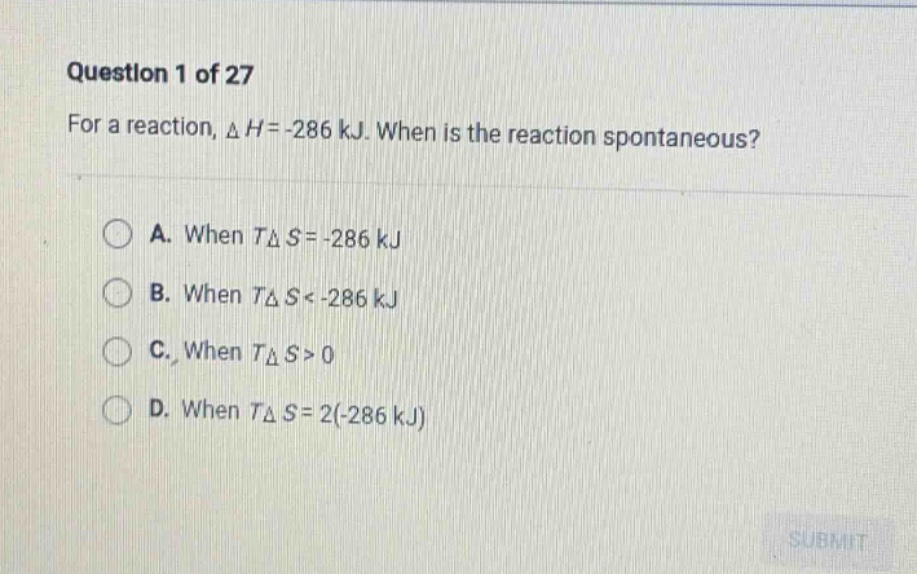
question 1 of 27 for a reaction, δh = -286 kj. when is the reaction spontaneous? a. when tδs = -286 kj b. when tδs < -286 kj c. when tδs > 0 d. when tδs = 2(-286 kj)
Answer
Explanation:
Step1: Recall spontaneity condition
A reaction is spontaneous when $\Delta G<0$, and $\Delta G = \Delta H - T\Delta S$.
Step2: Substitute given $\Delta H$
Given $\Delta H=- 286\ kJ$, so $\Delta G=-286 - T\Delta S$.
Step3: Set $\Delta G < 0$
We want $\Delta G<0$, so $-286 - T\Delta S<0$.
Step4: Solve for $T\Delta S$
Adding $286$ to both sides gives $-T\Delta S < 286$, or $T\Delta S>- 286$. Since we want a general - condition, when $T\Delta S>0$ (because if $T\Delta S>0$, it satisfies $T\Delta S > - 286$).
Answer:
C. When $T\Delta S>0$