reactant p contains 50 j of energy, and reactant q contains 35.3 j of energy. the reactants combine to form…
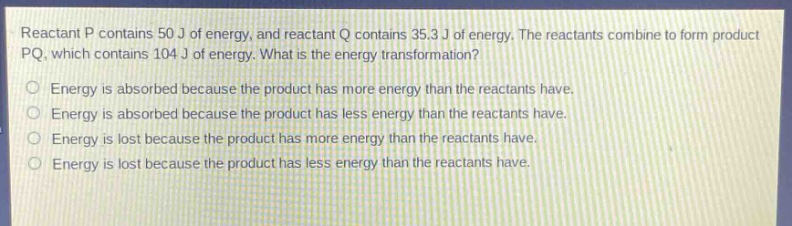
reactant p contains 50 j of energy, and reactant q contains 35.3 j of energy. the reactants combine to form product pq, which contains 104 j of energy. what is the energy transformation?\nenergy is absorbed because the product has more energy than the reactants have.\nenergy is absorbed because the product has less energy than the reactants have.\nenergy is lost because the product has more energy than the reactants have.\nenergy is lost because the product has less energy than the reactants have.
Answer
Explanation:
Step1: Calculate total energy of reactants
$50 + 35.3=85.3$ J
Step2: Compare energy of reactants and product
The energy of product PQ is 104 J. Since $104>85.3$, energy is absorbed.
Answer:
Energy is absorbed because the product has more energy than the reactants have.