the ___ for a reactant is the power to which the concentration of a reactant must be raised to give the…
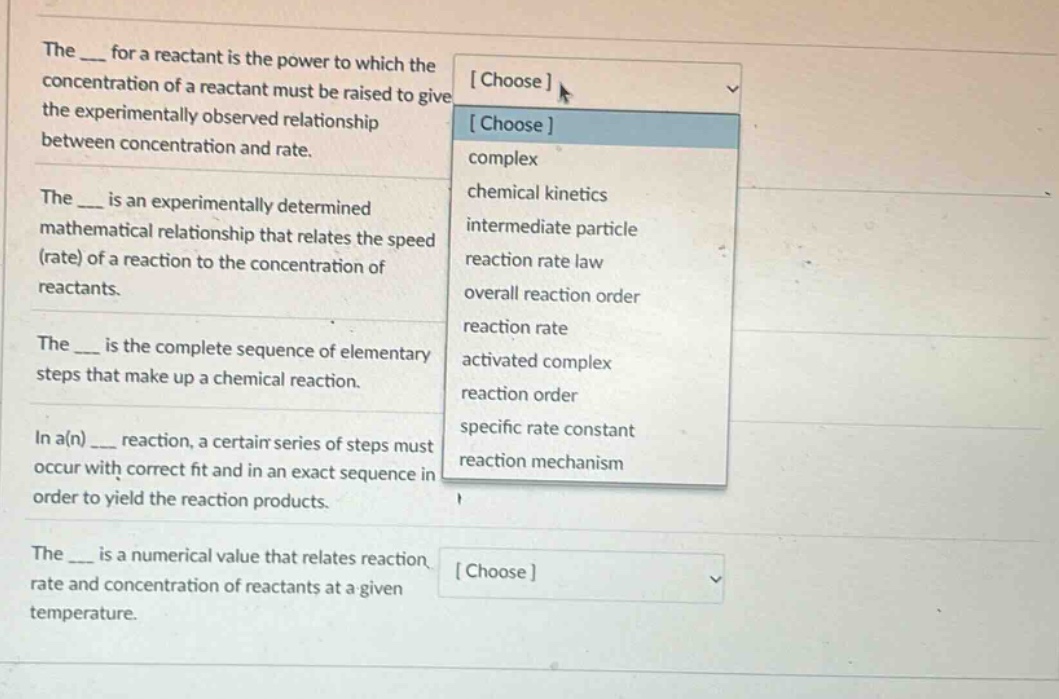
the ___ for a reactant is the power to which the concentration of a reactant must be raised to give the experimentally observed relationship between concentration and rate. the ___ is an experimentally determined mathematical relationship that relates the speed (rate) of a reaction to the concentration of reactants. the ___ is the complete sequence of elementary steps that make up a chemical reaction. in a(n) ___ reaction, a certain series of steps must occur with correct fit and in an exact sequence in order to yield the reaction products. the ___ is a numerical value that relates reaction rate and concentration of reactants at a given temperature. choose choose complex chemical kinetics intermediate particle reaction rate law overall reaction order reaction rate activated complex reaction order specific rate constant reaction mechanism
Answer
Brief Explanations:
- The power to which a reactant concentration is raised in the rate - concentration relationship is the reaction order.
- The experimentally - determined mathematical relationship between reaction rate and reactant concentration is the reaction rate law.
- The complete sequence of elementary steps in a chemical reaction is the reaction mechanism.
- In an elementary reaction, steps must occur in a specific sequence to form products.
- The numerical value relating reaction rate and reactant concentration at a given temperature is the specific rate constant.
Answer:
- reaction order
- reaction rate law
- reaction mechanism
- elementary
- specific rate constant