the reaction below was carried out in an acidic solution.\n mathrm{i}^{-}+mathrm{io}_{3}^{-}longrightarrowmat…
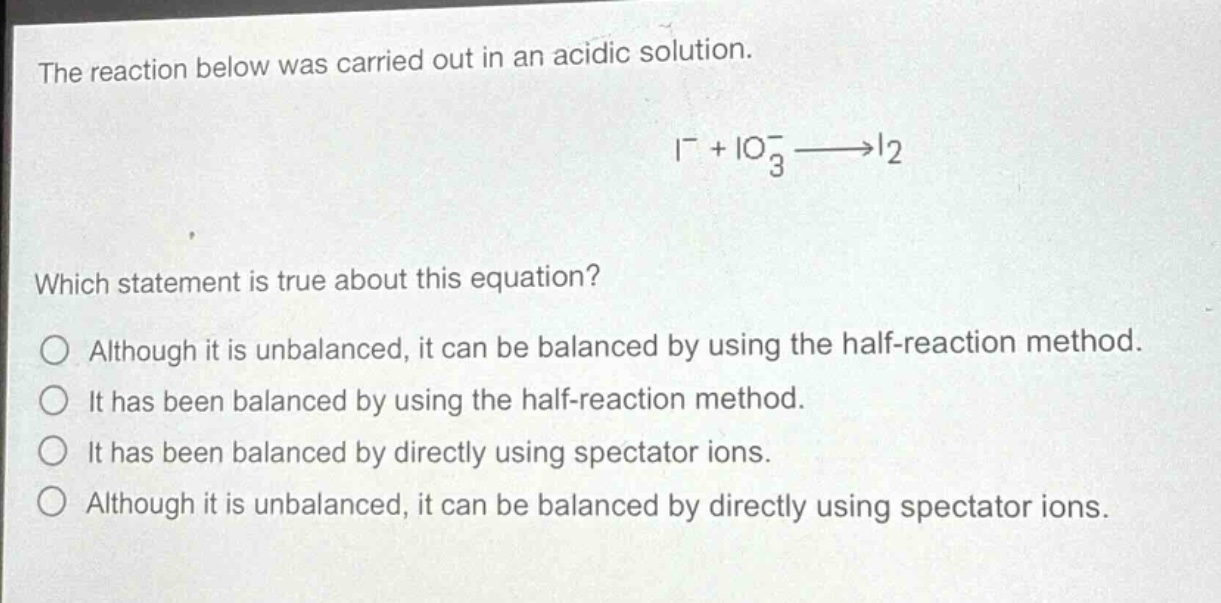
the reaction below was carried out in an acidic solution.\n mathrm{i}^{-}+mathrm{io}_{3}^{-}longrightarrowmathrm{i}_{2} \nwhich statement is true about this equation?\no although it is unbalanced, it can be balanced by using the half - reaction method.\no it has been balanced by using the half - reaction method.\no it has been balanced by directly using spectator ions.\no although it is unbalanced, it can be balanced by directly using spectator ions.
Answer
Brief Explanations:
The given chemical - reaction equation (I^-+IO_3^-\to I_2) is unbalanced. In an acidic solution, redox reactions like this one are typically balanced using the half - reaction method. Spectator ions are not used to balance the reaction itself; they are ions that do not participate in the actual chemical change. The half - reaction method involves splitting the overall reaction into oxidation and reduction half - reactions, balancing them separately for atoms and charge, and then combining them.
Answer:
A. Although it is unbalanced, it can be balanced by using the half - reaction method.