the reaction below demonstrates which characteristic of a base?\ncuso₄(aq) + 2naoh(aq) → cu(oh)₂(s) +…
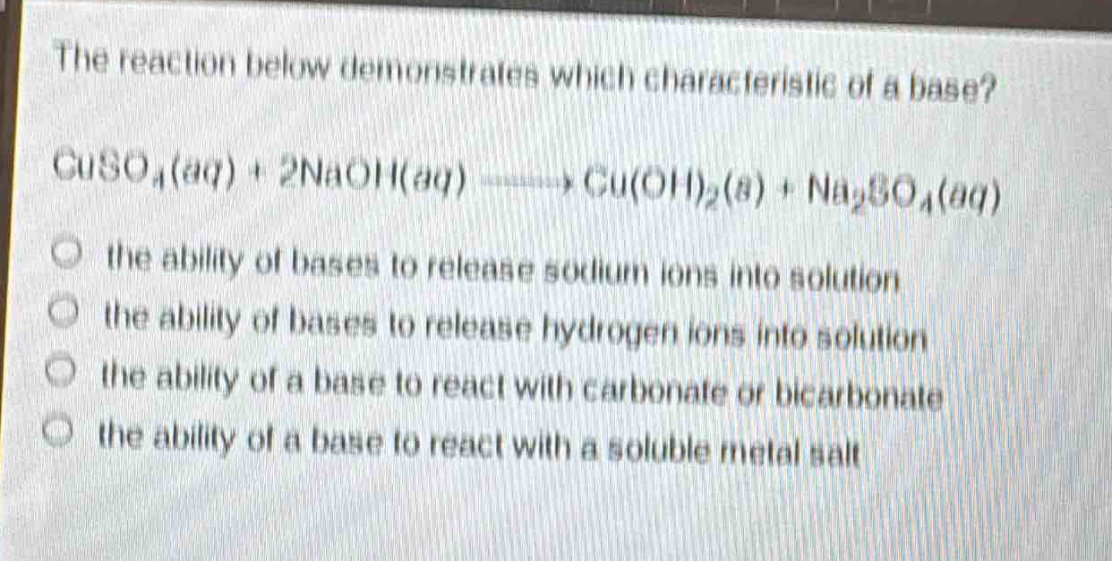
the reaction below demonstrates which characteristic of a base?\ncuso₄(aq) + 2naoh(aq) → cu(oh)₂(s) + na₂so₄(aq)\no the ability of bases to release sodium ions into solution\no the ability of bases to release hydrogen ions into solution\no the ability of a base to react with carbonate or bicarbonate\no the ability of a base to react with a soluble metal salt
Answer
Brief Explanations:
In the reaction, copper sulfate (a soluble metal salt) reacts with sodium hydroxide (a base) to form a precipitate of copper hydroxide and sodium sulfate. Bases can react with soluble metal salts to form metal - hydroxide precipitates. Bases do not release sodium ions as a general characteristic (only if the base contains sodium), they release hydroxide ions, not hydrogen ions. Also, the reaction does not involve carbonate or bicarbonate.
Answer:
the ability of a base to react with a soluble metal salt