which reaction displays an example of an arrhenius base?\no naoh(s) → na+(aq) + oh−(aq)\no hcl(g) + h2o(l) →…
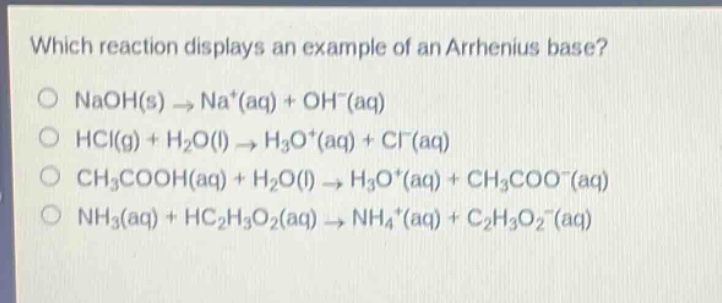
which reaction displays an example of an arrhenius base?\no naoh(s) → na+(aq) + oh−(aq)\no hcl(g) + h2o(l) → h3o+(aq) + cl−(aq)\no ch3cooh(aq) + h2o(l) → h3o+(aq) + ch3coo−(aq)\no nh3(aq) + hc2h3o2(aq) → nh4+(aq) + c2h3o2−(aq)
Answer
Answer:
A. $NaOH(s)\rightarrow Na^{+}(aq)+OH^{-}(aq)$
Explanation:
Step1: Recall Arrhenius base definition
An Arrhenius base produces $OH^{-}$ in aqueous solution.
Step2: Analyze each option
- Option A: $NaOH$ dissociates to give $Na^{+}$ and $OH^{-}$, which fits Arrhenius - base definition.
- Option B: $HCl$ is an Arrhenius acid as it produces $H_3O^{+}$ in water.
- Option C: $CH_3COOH$ is an acid as it donates a proton to water to form $H_3O^{+}$.
- Option D: This is an acid - base reaction between ammonia and acetic acid, not an example of an Arrhenius base dissociation.