which reaction displays an example of an arrhenius base? o naoh(s) → na+(aq) + oh−(aq) o hcl(g) + h2o(l) →…
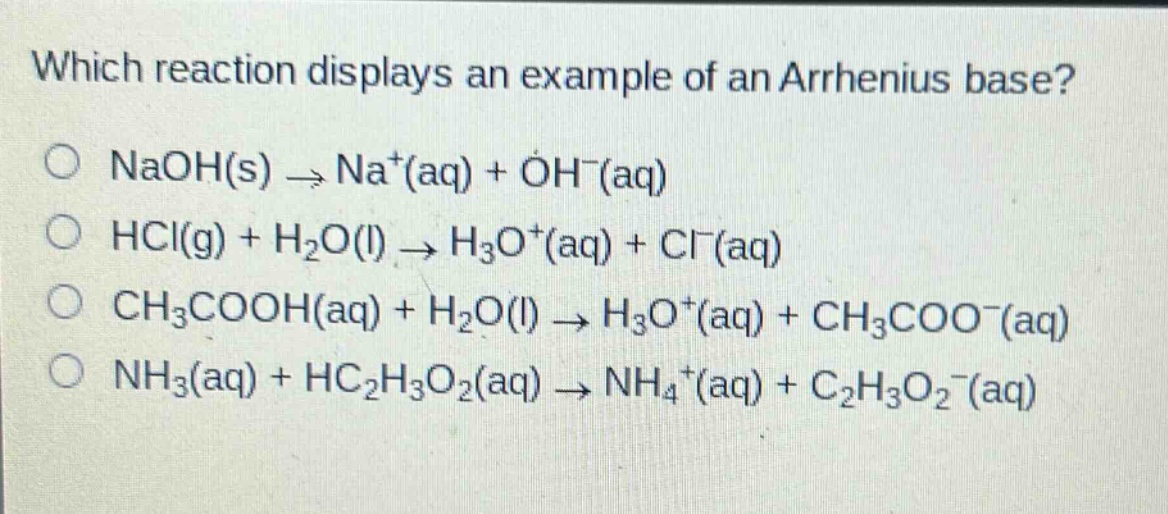
which reaction displays an example of an arrhenius base? o naoh(s) → na+(aq) + oh−(aq) o hcl(g) + h2o(l) → h3o+(aq) + cl−(aq) o ch3cooh(aq) + h2o(l) → h3o+(aq) + ch3coo−(aq) o nh3(aq) + hc2h3o2(aq) → nh4+(aq) + c2h3o2−(aq)
Answer
Brief Explanations:
An Arrhenius base is a substance that dissociates in water to produce hydroxide ions ($\text{OH}^-$). In the reaction $\text{NaOH}(s)\rightarrow\text{Na}^+(aq)+\text{OH}^-(aq)$, sodium - hydroxide dissociates in water to give sodium ions and hydroxide ions. The other reactions involve acids donating protons or acid - base neutralization reactions that do not represent Arrhenius bases.
Answer:
$\text{NaOH}(s)\rightarrow\text{Na}^+(aq)+\text{OH}^-(aq)$