the reaction of a lewis acid with a lewis base would most likely be accompanied by an increase in which…
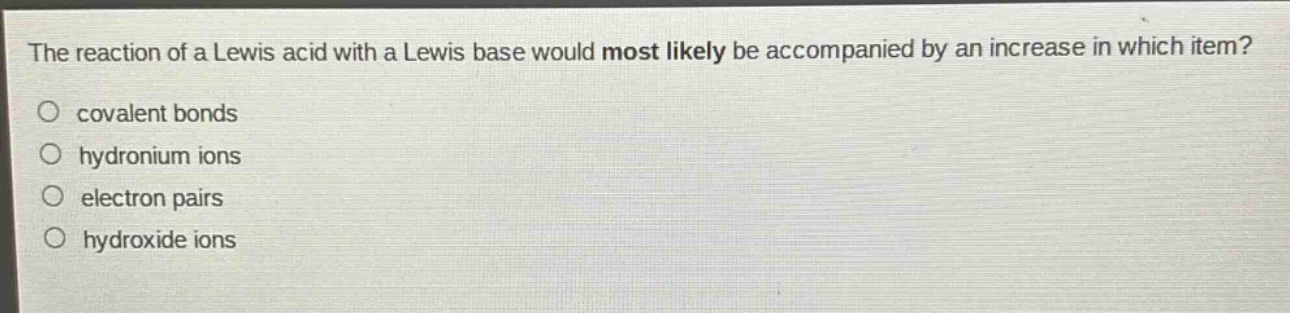
the reaction of a lewis acid with a lewis base would most likely be accompanied by an increase in which item?\ncovalent bonds\nhydronium ions\nelectron pairs\nhydroxide ions
Answer
Explanation:
Step1: Understand Lewis acid - base reaction
A Lewis acid is an electron - pair acceptor and a Lewis base is an electron - pair donor. When they react, they form a coordinate covalent bond. A coordinate covalent bond is a type of covalent bond.
Step2: Analyze each option
- Covalent bonds: In a Lewis acid - base reaction, a new covalent (coordinate covalent) bond is formed. For example, when (BF_3) (Lewis acid) reacts with (NH_3) (Lewis base), (BF_3+NH_3\rightarrow F_3B - NH_3), a new covalent bond ((B - N)) is created.
- Hydronium ions ((H_3O^{+})): Hydronium ions are related to Arrhenius or Brønsted - Lowry acid - base concepts (involving (H^{+}) transfer in water). Lewis acid - base reactions do not necessarily involve (H^{+}) transfer to form (H_3O^{+}).
- Electron pairs: The total number of electron pairs in the system does not increase. The Lewis base donates an electron pair to the Lewis acid, but the sum of electron pairs in the reactants and products (in terms of non - bonding and bonding pairs) does not increase in the sense of new electron pairs being created.
- Hydroxide ions ((OH^{-})): Hydroxide ions are related to Arrhenius or Brønsted - Lowry acid - base concepts (involving (OH^{-}) in water). Lewis acid - base reactions do not necessarily involve (OH^{-}) formation.
Answer:
covalent bonds