which reaction will most likely take place based on the activity series? li > k > ba > ca > na > mn > zn >…
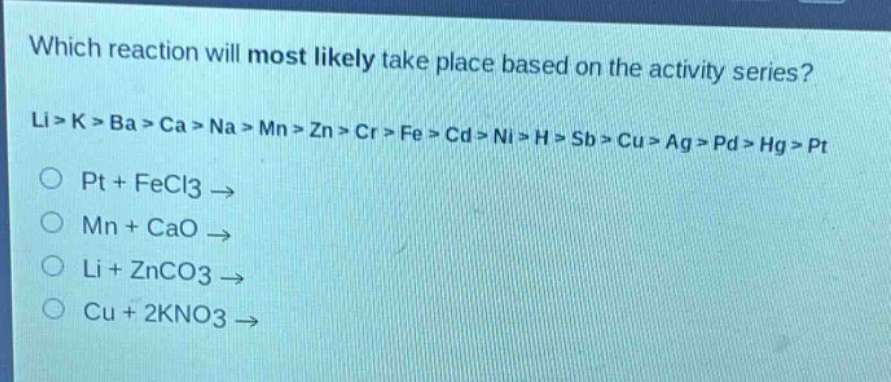
which reaction will most likely take place based on the activity series? li > k > ba > ca > na > mn > zn > cr > fe > cd > ni > h > sb > cu > ag > pd > hg > pt\no pt + fecl3 →\no mn + cao →\no li + znco3 →\no cu + 2kno3 →
Answer
Explanation:
Step1: Recall activity - series rule
A more reactive metal can displace a less reactive metal from its compound.
Step2: Analyze option 1
In $Pt + FeCl_3\rightarrow$, platinum (Pt) is less reactive than iron (Fe) according to the activity - series ($Fe>Pt$), so Pt cannot displace Fe from $FeCl_3$.
Step3: Analyze option 2
In $Mn + CaO\rightarrow$, calcium (Ca) is more reactive than manganese (Mn) ($Ca > Mn$), so Mn cannot displace Ca from CaO.
Step4: Analyze option 3
In $Li+ZnCO_3\rightarrow$, lithium (Li) is more reactive than zinc (Zn) ($Li > Zn$), so Li can displace Zn from $ZnCO_3$.
Step5: Analyze option 4
In $Cu + 2KNO_3\rightarrow$, potassium (K) is more reactive than copper (Cu) ($K>Cu$), so Cu cannot displace K from $KNO_3$.
Answer:
$Li + ZnCO_3\rightarrow$