which reaction will produce a solution that does not conduct electricity?\no ch₃oh(l) → ch₃oh(aq)\no…
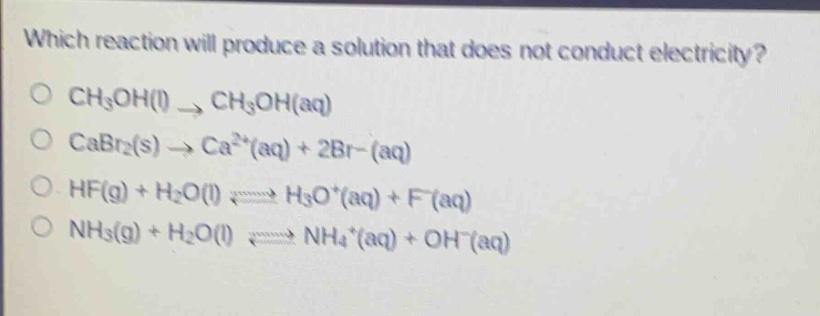
which reaction will produce a solution that does not conduct electricity?\no ch₃oh(l) → ch₃oh(aq)\no cabr₂(s) → ca²⁺(aq) + 2br⁻(aq)\no hf(g) + h₂o(l) ⇌ h₃o⁺(aq) + f⁻(aq)\no nh₃(g) + h₂o(l) ⇌ nh₄⁺(aq) + oh⁻(aq)
Answer
Explanation:
Step1: Recall conductivity concept
Conductivity in solutions is due to the presence of ions. Non - electrolytes do not dissociate into ions and their solutions do not conduct electricity.
Step2: Analyze each reaction
- For $\mathrm{CH_3OH(l)\to CH_3OH(aq)}$, methanol is a covalent compound and does not dissociate into ions in solution. So its solution will not conduct electricity.
- For $\mathrm{CaBr_2(s)\to Ca^{2 + }(aq)+2Br^-(aq)}$, calcium bromide is an ionic compound and dissociates into ions in solution, so the solution will conduct electricity.
- For $\mathrm{HF(g)+H_2O(l)\rightleftharpoons H_3O^+(aq)+F^-(aq)}$, hydrogen fluoride is a weak acid and dissociates to form ions in solution, so the solution will conduct electricity.
- For $\mathrm{NH_3(g)+H_2O(l)\rightleftharpoons NH_4^+(aq)+OH^-(aq)}$, ammonia reacts with water to form ions in solution, so the solution will conduct electricity.
Answer:
$\mathrm{CH_3OH(l)\to CH_3OH(aq)}$