which reactions are oxidation - reduction reactions? check all that apply.\n2na + cl₂ → 2nacl\npb(oh)₂ → pbo…
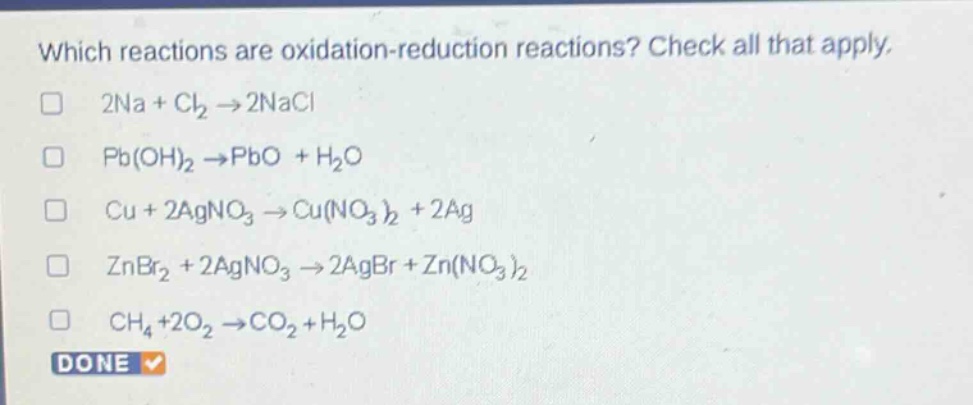
which reactions are oxidation - reduction reactions? check all that apply.\n2na + cl₂ → 2nacl\npb(oh)₂ → pbo + h₂o\ncu + 2agno₃ → cu(no₃)₂ + 2ag\nznbr₂ + 2agno₃ → 2agbr + zn(no₃)₂\nch₄+2o₂ → co₂ + h₂o
Answer
Explanation:
Step1: Recall redox - reaction criteria
Oxidation - reduction reactions involve a change in oxidation states of elements.
Step2: Analyze 2Na + Cl₂ → 2NaCl
Sodium (Na) goes from 0 to +1 oxidation state and chlorine (Cl) goes from 0 to - 1. It is a redox reaction.
Step3: Analyze Pb(OH)₂ → PbO + H₂O
No change in oxidation states of Pb, O, and H. It is not a redox reaction.
Step4: Analyze Cu + 2AgNO₃ → Cu(NO₃)₂ + 2Ag
Copper (Cu) goes from 0 to +2 and silver (Ag) goes from +1 to 0. It is a redox reaction.
Step5: Analyze ZnBr₂ + 2AgNO₃ → 2AgBr + Zn(NO₃)₂
No change in oxidation states of Zn, Br, Ag, N, and O. It is a double - displacement reaction, not a redox reaction.
Step6: Analyze CH₄+2O₂ → CO₂ + H₂O
Carbon (C) in CH₄ changes from - 4 to +4 in CO₂ and oxygen (O) changes from 0 to - 2. It is a redox reaction.
Answer:
2Na + Cl₂ → 2NaCl, Cu + 2AgNO₃ → Cu(NO₃)₂ + 2Ag, CH₄+2O₂ → CO₂ + H₂O