which reactions are oxidation - reduction reactions? check all that apply.\n□ fes(s) + 2hcl(aq) → h₂s(g) +…
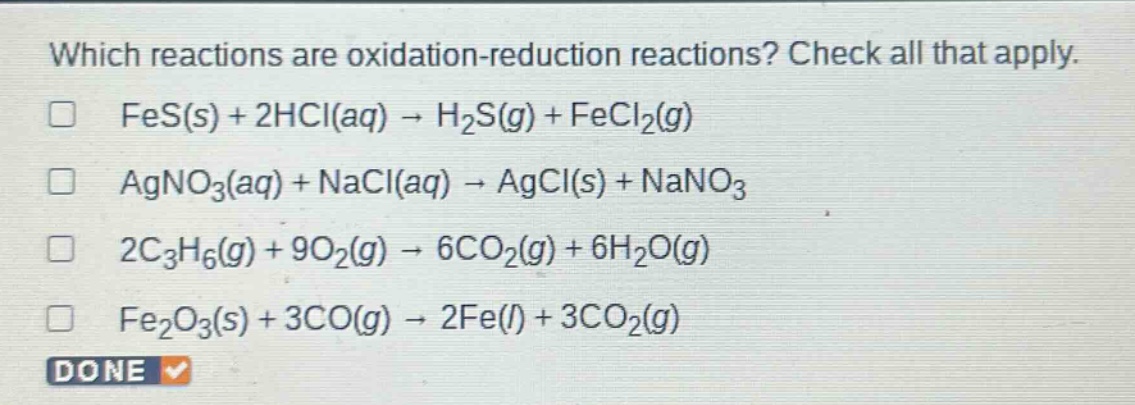
which reactions are oxidation - reduction reactions? check all that apply.\n□ fes(s) + 2hcl(aq) → h₂s(g) + fecl₂(g)\n□ agno₃(aq) + nacl(aq) → agcl(s) + nano₃\n□ 2c₃h₆(g) + 9o₂(g) → 6co₂(g) + 6h₂o(g)\n□ fe₂o₃(s) + 3co(g) → 2fe(l) + 3co₂(g)\ndone
Answer
Explanation:
Step1: Recall redox - reaction criteria
Oxidation - reduction reactions involve a change in oxidation numbers of elements.
Step2: Analyze reaction 1
For $\text{FeS}(s)+2\text{HCl}(aq)\rightarrow\text{H}_2\text{S}(g)+\text{FeCl}_2(g)$, the oxidation numbers of $\text{Fe}$, $\text{S}$, $\text{H}$, and $\text{Cl}$ do not change. So it is not a redox reaction.
Step3: Analyze reaction 2
For $\text{AgNO}_3(aq)+\text{NaCl}(aq)\rightarrow\text{AgCl}(s)+\text{NaNO}_3$, this is a double - displacement reaction and there is no change in oxidation numbers. So it is not a redox reaction.
Step4: Analyze reaction 3
For $2\text{C}_3\text{H}_6(g)+9\text{O}_2(g)\rightarrow6\text{CO}_2(g)+6\text{H}_2\text{O}(g)$, carbon is oxidized (its oxidation number increases from - 2 in $\text{C}_3\text{H}_6$ to +4 in $\text{CO}_2$) and oxygen is reduced (its oxidation number decreases from 0 in $\text{O}_2$ to -2 in $\text{CO}_2$ and $\text{H}_2\text{O}$). So it is a redox reaction.
Step5: Analyze reaction 4
For $\text{Fe}_2\text{O}_3(s)+3\text{CO}(g)\rightarrow2\text{Fe}(l)+3\text{CO}_2(g)$, iron is reduced (its oxidation number decreases from +3 in $\text{Fe}_2\text{O}_3$ to 0 in $\text{Fe}$) and carbon is oxidized (its oxidation number increases from +2 in $\text{CO}$ to +4 in $\text{CO}_2$). So it is a redox reaction.
Answer:
2C₃H₆(g) + 9O₂(g) → 6CO₂(g) + 6H₂O(g), Fe₂O₃(s) + 3CO(g) → 2Fe(l) + 3CO₂(g)