with a reduction in the secondary consumer, what happens to the quaternary consumer?\nthe tertiary consumer…
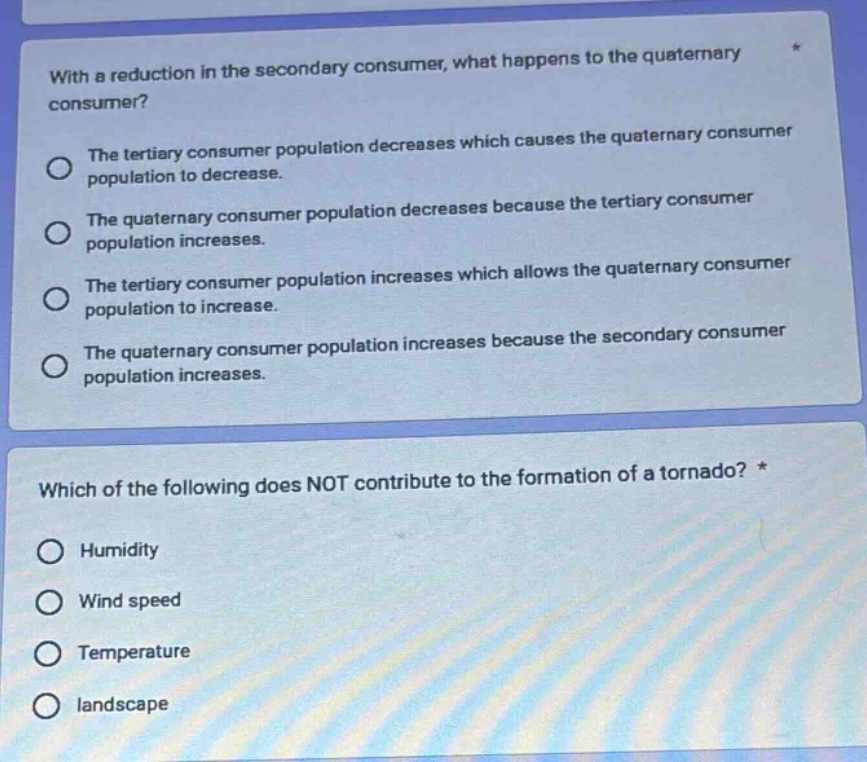
with a reduction in the secondary consumer, what happens to the quaternary consumer?\nthe tertiary consumer population decreases which causes the quaternary consumer population to decrease.\nthe quaternary consumer population decreases because the tertiary consumer population increases.\nthe tertiary consumer population increases which allows the quaternary consumer population to increase.\nthe quaternary consumer population increases because the secondary consumer population increases.\nwhich of the following does not contribute to the formation of a tornado? *\nhumidity\nwind speed\ntemperature\nlandscape
Answer
Brief Explanations:
- In a food - chain, a reduction in secondary consumers leads to a decrease in the tertiary consumer population as their food source is reduced. A decrease in the tertiary consumer population then causes a decrease in the quaternary consumer population due to less food availability for quaternary consumers.
- Tornado formation is influenced by humidity (moisture in the air), wind speed (wind shear is important), and temperature (temperature gradients help create instability). Landscape has a relatively minor impact compared to these meteorological factors.
Answer:
- The tertiary consumer population decreases which causes the quaternary consumer population to decrease.
- landscape