which represents a double replacement reaction and would occur?\no nh₄no₃(aq) + agclo₃(aq) → agno₃(aq) +…
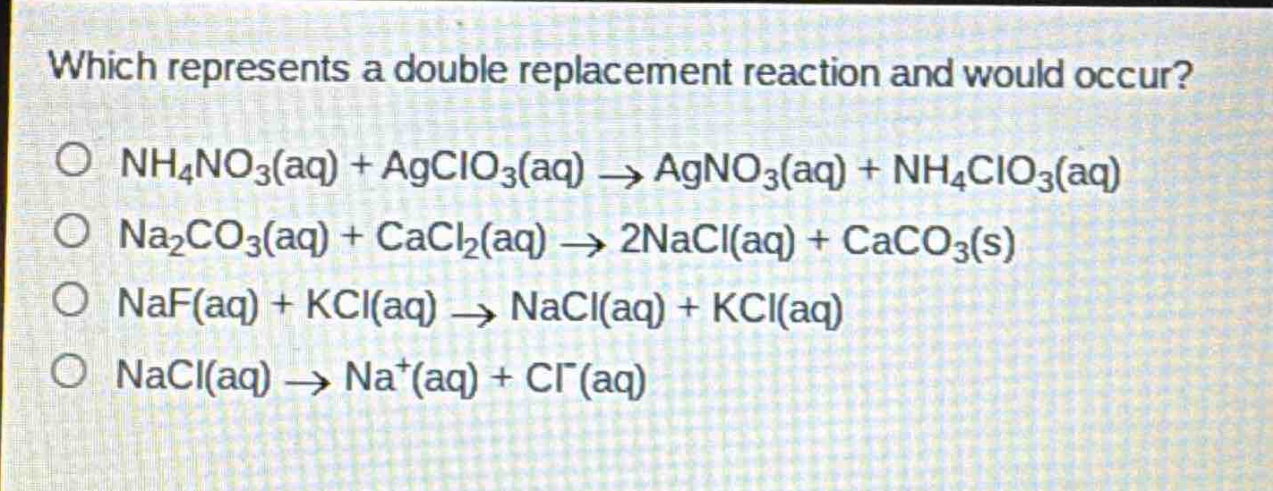
which represents a double replacement reaction and would occur?\no nh₄no₃(aq) + agclo₃(aq) → agno₃(aq) + nh₄clo₃(aq)\no na₂co₃(aq) + cacl₂(aq) → 2nacl(aq) + caco₃(s)\no naf(aq) + kcl(aq) → nacl(aq) + kcl(aq)\no nacl(aq) → na⁺(aq) + cl⁻(aq)
Answer
Explanation:
Step1: Recall double - replacement reaction definition
A double - replacement reaction has the general form (AB + CD\rightarrow AD+CB), where the cations and anions of two ionic compounds exchange places. Also, for the reaction to occur, a precipitate, gas, or water must be formed.
Step2: Analyze the first option
For (NH_4NO_3(aq)+AgClO_3(aq)\rightarrow AgNO_3(aq)+NH_4ClO_3(aq)), all products are aqueous. No precipitate, gas, or water is formed, so the reaction does not occur.
Step3: Analyze the second option
For (Na_2CO_3(aq)+CaCl_2(aq)\rightarrow 2NaCl(aq)+CaCO_3(s)), it is a double - replacement reaction ((Na) and (Ca) exchange anions). A precipitate ((CaCO_3)) is formed, so the reaction occurs.
Step4: Analyze the third option
For (NaF(aq)+KCl(aq)\rightarrow NaCl(aq)+KCl(aq)), this is not a valid reaction as no new products are formed. The right - hand side has the same ions as the left - hand side.
Step5: Analyze the fourth option
For (NaCl(aq)\rightarrow Na^{+}(aq)+Cl^{-}(aq)), this is a dissociation reaction, not a double - replacement reaction.
Answer:
(Na_2CO_3(aq)+CaCl_2(aq)\rightarrow 2NaCl(aq)+CaCO_3(s))