which represents the ionization of a strong electrolyte?\no ch₃oh(l) → ch₃oh(aq)\no k₃po₄(s) → 3k⁺(aq) +…
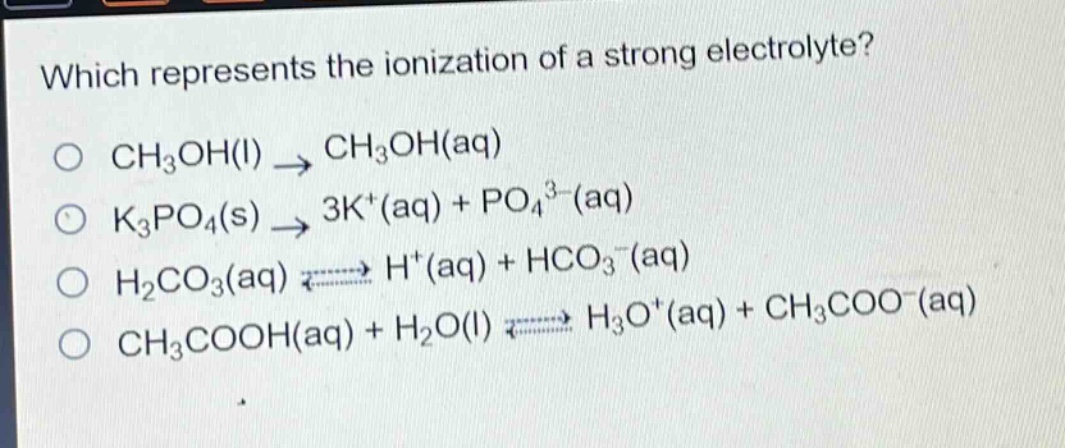
which represents the ionization of a strong electrolyte?\no ch₃oh(l) → ch₃oh(aq)\no k₃po₄(s) → 3k⁺(aq) + po₄³⁻(aq)\no h₂co₃(aq) ⇌ h⁺(aq) + hco₃⁻(aq)\no ch₃cooh(aq) + h₂o(l) ⇌ h₃o⁺(aq) + ch₃coo⁻(aq)
Answer
Brief Explanations:
A strong electrolyte completely ionizes in solution. Potassium phosphate ($K_3PO_4$) is an ionic compound and dissociates completely into its ions in water. Methanol ($CH_3OH$) is a non - electrolyte. Carbonic acid ($H_2CO_3$) and acetic acid ($CH_3COOH$) are weak electrolytes as they only partially ionize (shown by the reversible arrows).
Answer:
$K_3PO_4(s)\rightarrow3K^{+}(aq)+PO_4^{3 - }(aq)$