the resonance hybrid of the perchlorate ion, clo₄⁻, is described by 16 resonance structures, a…
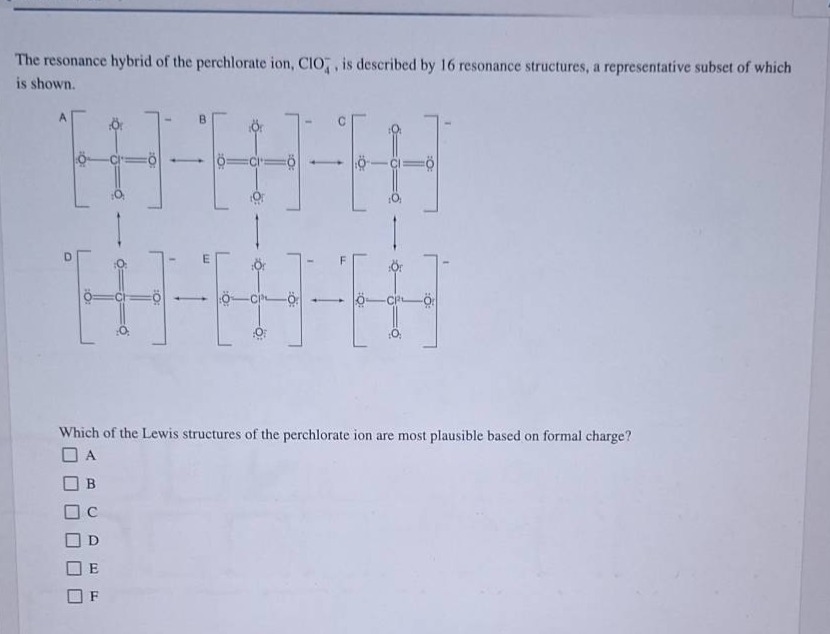
the resonance hybrid of the perchlorate ion, clo₄⁻, is described by 16 resonance structures, a representative subset of which is shown. which of the lewis structures of the perchlorate ion are most plausible based on formal charge? a b c d e f
Answer
Explanation:
Step1: Recall formal - charge formula
The formal - charge formula is $FC = V - N - \frac{B}{2}$, where $V$ is the number of valence electrons of the atom in isolation, $N$ is the number of non - bonding electrons, and $B$ is the number of bonding electrons. For chlorine in $ClO_4^-$: Chlorine has 7 valence electrons ($V = 7$). For oxygen: Oxygen has 6 valence electrons ($V = 6$).
Step2: Analyze structure A
In structure A, for the central chlorine atom: $N = 0$, $B = 8$, so $FC_{Cl}=7 - 0-\frac{8}{2}=3$. For each oxygen atom: $N = 6$, $B = 2$, so $FC_O=6 - 6-\frac{2}{2}=- 1$.
Step3: Analyze structure B
For the central chlorine atom: $N = 0$, $B = 8$, so $FC_{Cl}=7 - 0-\frac{8}{2}=3$. For the double - bonded oxygen: $N = 4$, $B = 4$, so $FC_O=6 - 4-\frac{4}{2}=0$. For the single - bonded oxygen: $N = 6$, $B = 2$, so $FC_O=6 - 6-\frac{2}{2}=-1$.
Step4: Analyze structure C
For the central chlorine atom: $N = 0$, $B = 8$, so $FC_{Cl}=7 - 0-\frac{8}{2}=3$. For the double - bonded oxygen: $N = 4$, $B = 4$, so $FC_O=6 - 4-\frac{4}{2}=0$. For the single - bonded oxygen: $N = 6$, $B = 2$, so $FC_O=6 - 6-\frac{2}{2}=-1$.
Step5: Analyze structure D
For the central chlorine atom: $N = 0$, $B = 8$, so $FC_{Cl}=7 - 0-\frac{8}{2}=3$. For each oxygen atom: $N = 6$, $B = 2$, so $FC_O=6 - 6-\frac{2}{2}=-1$.
Step6: Analyze structure E
For the central chlorine atom: $N = 0$, $B = 8$, so $FC_{Cl}=7 - 0-\frac{8}{2}=3$. For the double - bonded oxygen: $N = 4$, $B = 4$, so $FC_O=6 - 4-\frac{4}{2}=0$. For the single - bonded oxygen: $N = 6$, $B = 2$, so $FC_O=6 - 6-\frac{2}{2}=-1$.
Step7: Analyze structure F
For the central chlorine atom: $N = 0$, $B = 8$, so $FC_{Cl}=7 - 0-\frac{8}{2}=3$. For the double - bonded oxygen: $N = 4$, $B = 4$, so $FC_O=6 - 4-\frac{4}{2}=0$. For the single - bonded oxygen: $N = 6$, $B = 2$, so $FC_O=6 - 6-\frac{2}{2}=-1$.
The most plausible Lewis structures have the lowest formal charges. In the case of $ClO_4^-$, structures with double - bonds between chlorine and oxygen are more stable as they reduce the formal charge on chlorine. Structures B, C, E, F have a more reasonable formal - charge distribution compared to A and D.
Answer:
B, C, E, F