rocket engines can be fueled by liquid hydrogen. the liquid hydrogen reacts with liquid oxygen, producing…
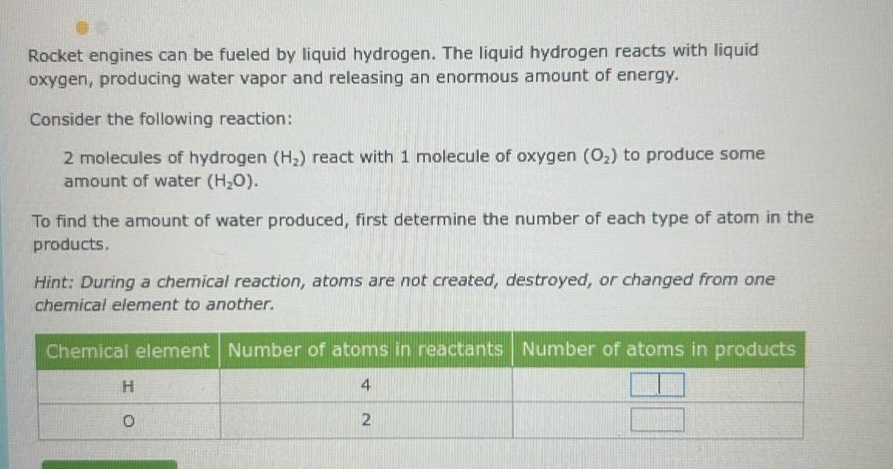
rocket engines can be fueled by liquid hydrogen. the liquid hydrogen reacts with liquid oxygen, producing water vapor and releasing an enormous amount of energy. consider the following reaction: 2 molecules of hydrogen (h₂) react with 1 molecule of oxygen (o₂) to produce some amount of water (h₂o). to find the amount of water produced, first determine the number of each type of atom in the products. hint: during a chemical reaction, atoms are not created, destroyed, or changed from one chemical element to another. chemical element number of atoms in reactants number of atoms in products h 4 o 2
Answer
Explanation:
Step1: Apply law of conservation of mass
According to the law of conservation of mass, the number of atoms of each element in the reactants is equal to the number of atoms of that element in the products in a chemical - reaction.
Step2: Determine number of H atoms in products
Since there are 4 H atoms in the reactants, the number of H atoms in the products is also 4.
Step3: Determine number of O atoms in products
Since there are 2 O atoms in the reactants, the number of O atoms in the products is also 2.
Answer:
| Chemical element | Number of atoms in products |
|---|---|
| H | 4 |
| O | 2 |