rolf prepares four solutions using different solutes as shown in the table below.\n|solution|preparation|solu…
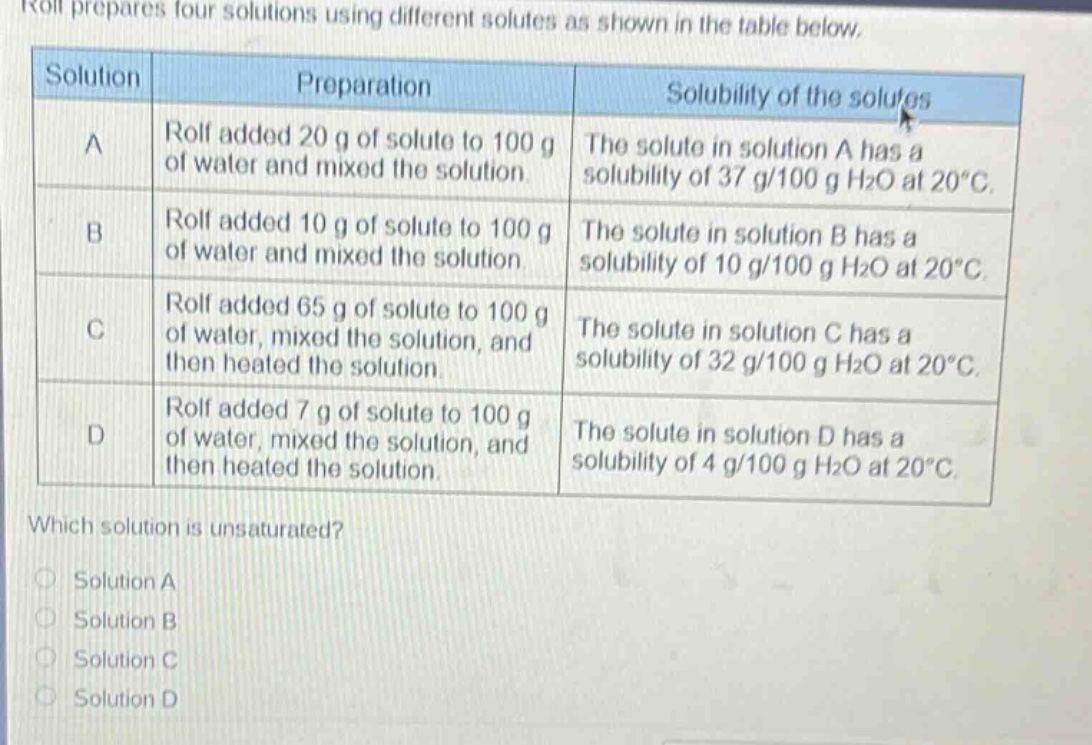
rolf prepares four solutions using different solutes as shown in the table below.\n|solution|preparation|solubility of the solutes|\n|----|----|----|\n|a|rolf added 20 g of solute to 100 g of water and mixed the solution.|the solute in solution a has a solubility of 37 g/100 g h₂o at 20°c.| \n|b|rolf added 10 g of solute to 100 g of water and mixed the solution.|the solute in solution b has a solubility of 10 g/100 g h₂o at 20°c.| \n|c|rolf added 65 g of solute to 100 g of water, mixed the solution, and then heated the solution.|the solute in solution c has a solubility of 32 g/100 g h₂o at 20°c.| \n|d|rolf added 7 g of solute to 100 g of water, mixed the solution, and then heated the solution.|the solute in solution d has a solubility of 4 g/100 g h₂o at 20°c.| \nwhich solution is unsaturated?\nsolution a\nsolution b\nsolution c\nsolution d
Answer
Explanation:
Step1: Recall unsaturated solution concept
An unsaturated solution has less solute dissolved than its solubility at a given temperature.
Step2: Analyze Solution A
The solubility is 37 g/100 g $H_2O$ at 20°C and 20 g of solute is added. Since 20 g < 37 g, it is unsaturated.
Step3: Analyze Solution B
The solubility is 10 g/100 g $H_2O$ at 20°C and 10 g of solute is added. This is a saturated solution (not unsaturated).
Step4: Analyze Solution C
The solubility is 32 g/100 g $H_2O$ at 20°C and 65 g of solute is added. It is supersaturated (more solute than solubility), not unsaturated.
Step5: Analyze Solution D
The solubility is 4 g/100 g $H_2O$ at 20°C and 7 g of solute is added. It is supersaturated, not unsaturated.
Answer:
Solution A