each row of the table below describes an aqueous solution at 25 °c. the second column of the table shows the…
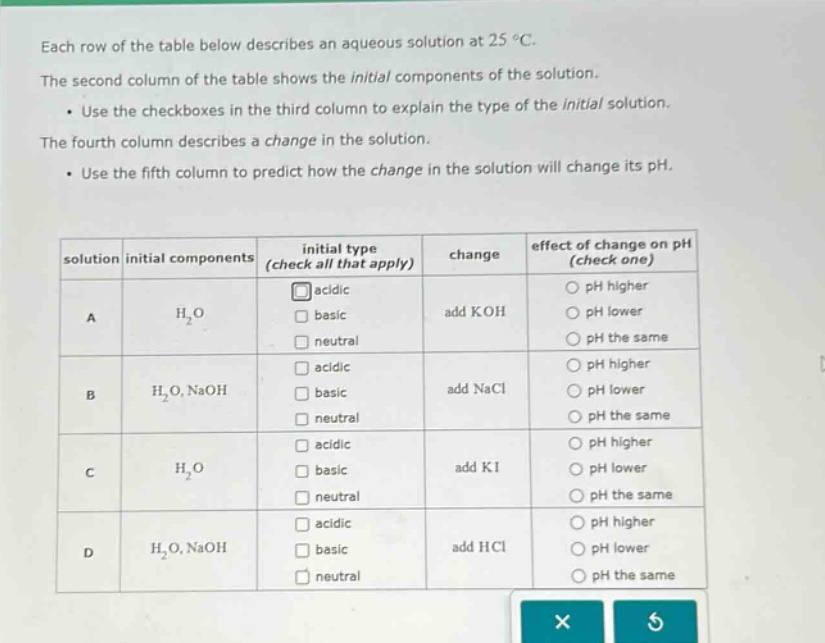
each row of the table below describes an aqueous solution at 25 °c. the second column of the table shows the initial components of the solution. • use the checkboxes in the third column to explain the type of the initial solution. the fourth column describes a change in the solution. • use the fifth column to predict how the change in the solution will change its ph. solution initial components initial type (check all that apply) change effect of change on ph (check one) a h₂o acidic add koh ph higher basic ph lower neutral ph the same b h₂o, naoh acidic add nacl ph higher basic ph lower neutral ph the same c h₂o acidic add ki ph higher basic ph lower neutral ph the same d h₂o, naoh acidic add hcl ph higher basic ph lower neutral ph the same
Answer
Explanation:
Step1: Analyze solution A
Water ($H_2O$) is neutral. Adding $KOH$ (a strong - base) increases $OH^-$ concentration, so $pH$ increases.
Step2: Analyze solution B
A solution of $H_2O$ and $NaOH$ is basic. Adding $NaCl$ (a neutral salt) does not affect $H^+$ or $OH^-$ concentration, so $pH$ remains the same.
Step3: Analyze solution C
Water ($H_2O$) is neutral. Adding $KI$ (a neutral salt) does not affect $H^+$ or $OH^-$ concentration, so $pH$ remains the same.
Step4: Analyze solution D
A solution of $H_2O$ and $NaOH$ is basic. Adding $HCl$ (a strong - acid) reacts with $NaOH$, decreasing $OH^-$ concentration, so $pH$ decreases.
Answer:
| solution | initial components | initial type (check all that apply) | change | effect of change on pH (check one) |
|---|---|---|---|---|
| A | $H_2O$ | neutral | add $KOH$ | pH higher |
| B | $H_2O, NaOH$ | basic | add $NaCl$ | pH the same |
| C | $H_2O$ | neutral | add $KI$ | pH the same |
| D | $H_2O, NaOH$ | basic | add $HCl$ | pH lower |