rubber is made from long - chain molecules, called polymers, which are normally all scrunched up. when you…
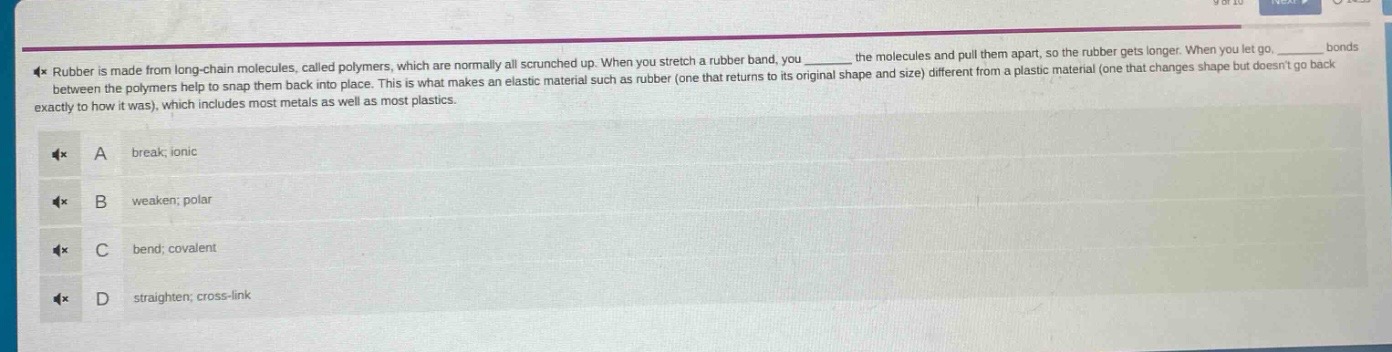
rubber is made from long - chain molecules, called polymers, which are normally all scrunched up. when you stretch a rubber band, you ______ the molecules and pull them apart, so the rubber gets longer. when you let go, ______ bonds between the polymers help to snap them back into place. this is what makes an elastic material such as rubber (one that returns to its original shape and size) different from a plastic material (one that changes shape but doesnt go back exactly to how it was), which includes most metals as well as most plastics.\na break; ionic\nb weaken; polar\nc bend; covalent\nd straighten; cross - link
Answer
Brief Explanations:
When stretching a rubber - band, the long - chain polymer molecules which are initially scrunched up get straightened. Cross - link bonds between the polymers help the rubber return to its original shape when released. Ionic bonds are not relevant here as rubber is not an ionic material. Polar and covalent bonds don't explain the stretching and returning behavior in this context as specifically as cross - link bonds do.
Answer:
D. straighten; cross - link