salicylic acid (c₇h₆o₃) reacts with acetic anhydride (c₄h₆o₃) to form acetylsalicylic acid…
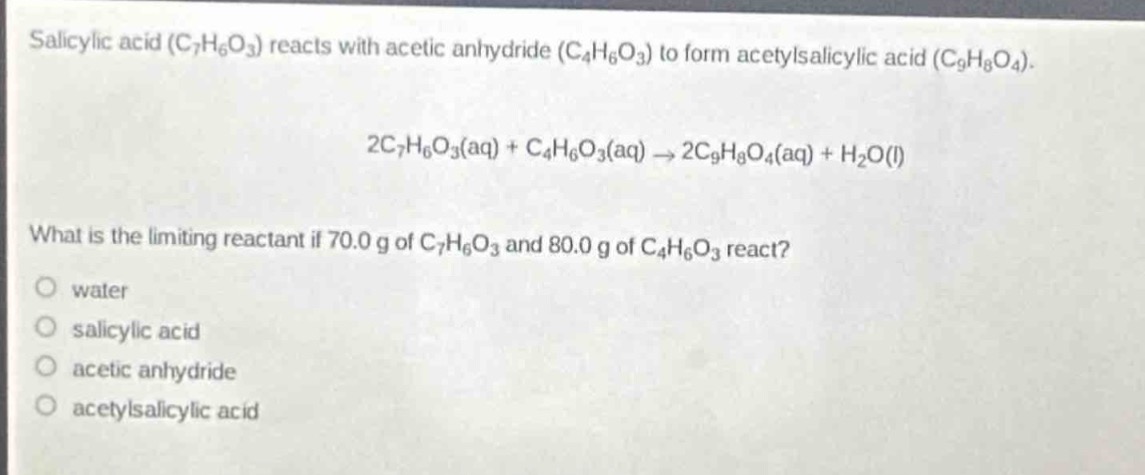
salicylic acid (c₇h₆o₃) reacts with acetic anhydride (c₄h₆o₃) to form acetylsalicylic acid (c₉h₈o₄).\n2c₇h₆o₃(aq) + c₄h₆o₃(aq) → 2c₉h₈o₄(aq) + h₂o(l)\nwhat is the limiting reactant if 70.0 g of c₇h₆o₃ and 80.0 g of c₄h₆o₃ react?\no water\no salicylic acid\no acetic anhydride\no acetylsalicylic acid
Answer
Explanation:
Step1: Calculate molar masses
The molar mass of $C_7H_6O_3$: $M_{C_7H_6O_3}=(7\times12.01 + 6\times1.01+3\times16.00)\text{ g/mol}=138.12\text{ g/mol}$ The molar mass of $C_4H_6O_3$: $M_{C_4H_6O_3}=(4\times12.01 + 6\times1.01+3\times16.00)\text{ g/mol}=102.09\text{ g/mol}$
Step2: Calculate moles of reactants
The number of moles of $C_7H_6O_3$, $n_{C_7H_6O_3}=\frac{m}{M}=\frac{70.0\text{ g}}{138.12\text{ g/mol}}\approx0.507\text{ mol}$ The number of moles of $C_4H_6O_3$, $n_{C_4H_6O_3}=\frac{m}{M}=\frac{80.0\text{ g}}{102.09\text{ g/mol}}\approx0.784\text{ mol}$
Step3: Determine mole - ratio from balanced equation
From the balanced equation $2C_7H_6O_3(aq)+C_4H_6O_3(aq)\to2C_9H_8O_4(aq)+H_2O(l)$, the mole - ratio of $C_7H_6O_3$ to $C_4H_6O_3$ is $n_{C_7H_6O_3}/n_{C_4H_6O_3}=2/1$
Step4: Calculate moles of one reactant needed to react with the other
If all $0.784$ mol of $C_4H_6O_3$ reacts, the moles of $C_7H_6O_3$ required is $n = 2\times0.784\text{ mol}=1.568\text{ mol}$ But we only have $0.507$ mol of $C_7H_6O_3$. So $C_7H_6O_3$ is the limiting reactant.
Answer:
salicylic acid