a sample of ammonia reacts with oxygen as shown.\n4nh₃(g) + 5o₂(g) → 4no(g) + 6h₂o(g)\nwhat is the limiting…
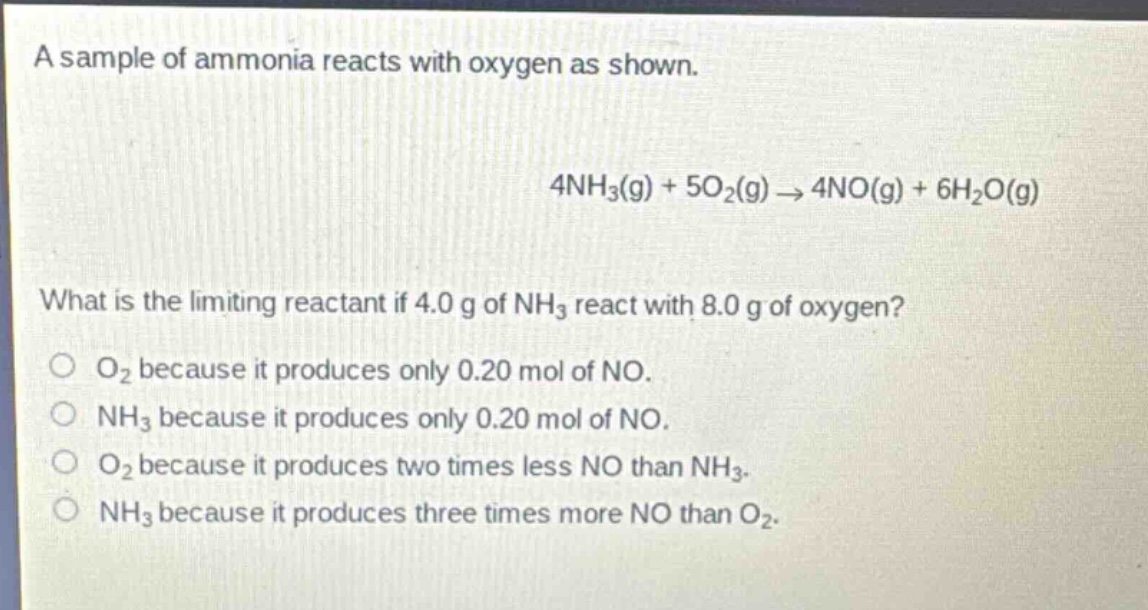
a sample of ammonia reacts with oxygen as shown.\n4nh₃(g) + 5o₂(g) → 4no(g) + 6h₂o(g)\nwhat is the limiting reactant if 4.0 g of nh₃ react with 8.0 g of oxygen?\no₂ because it produces only 0.20 mol of no.\nnh₃ because it produces only 0.20 mol of no.\no₂ because it produces two times less no than nh₃.\nnh₃ because it produces three times more no than o₂.
Answer
Explanation:
Step1: Calculate moles of $NH_3$
The molar mass of $NH_3$ is $M_{NH_3}=14 + 3\times1= 17\ g/mol$. The number of moles of $NH_3$, $n_{NH_3}=\frac{m_{NH_3}}{M_{NH_3}}=\frac{4.0\ g}{17\ g/mol}\approx0.235\ mol$.
Step2: Calculate moles of $O_2$
The molar mass of $O_2$ is $M_{O_2} = 2\times16=32\ g/mol$. The number of moles of $O_2$, $n_{O_2}=\frac{m_{O_2}}{M_{O_2}}=\frac{8.0\ g}{32\ g/mol}=0.25\ mol$.
Step3: Determine moles of $NO$ produced from each reactant
From the balanced - equation $4NH_3(g)+5O_2(g)\rightarrow4NO(g) + 6H_2O(g)$, the mole - ratio of $NH_3$ to $NO$ is $4:4 = 1:1$, so the moles of $NO$ produced from $NH_3$, $n_{NO1}=n_{NH_3}\approx0.235\ mol$. The mole - ratio of $O_2$ to $NO$ is $5:4$, so the moles of $NO$ produced from $O_2$, $n_{NO2}=n_{O_2}\times\frac{4}{5}=0.25\ mol\times\frac{4}{5}=0.20\ mol$.
Step4: Identify the limiting reactant
The reactant that produces the least amount of product is the limiting reactant. Since $O_2$ produces $0.20\ mol$ of $NO$ and $NH_3$ produces approximately $0.235\ mol$ of $NO$, $O_2$ is the limiting reactant.
Answer:
$O_2$ because it produces only $0.20\ mol$ of $NO$.