how does a sample of hydrogen at 10 °c compare to a sample of hydrogen at 350 k?\nthe hydrogen at 10 °c has…
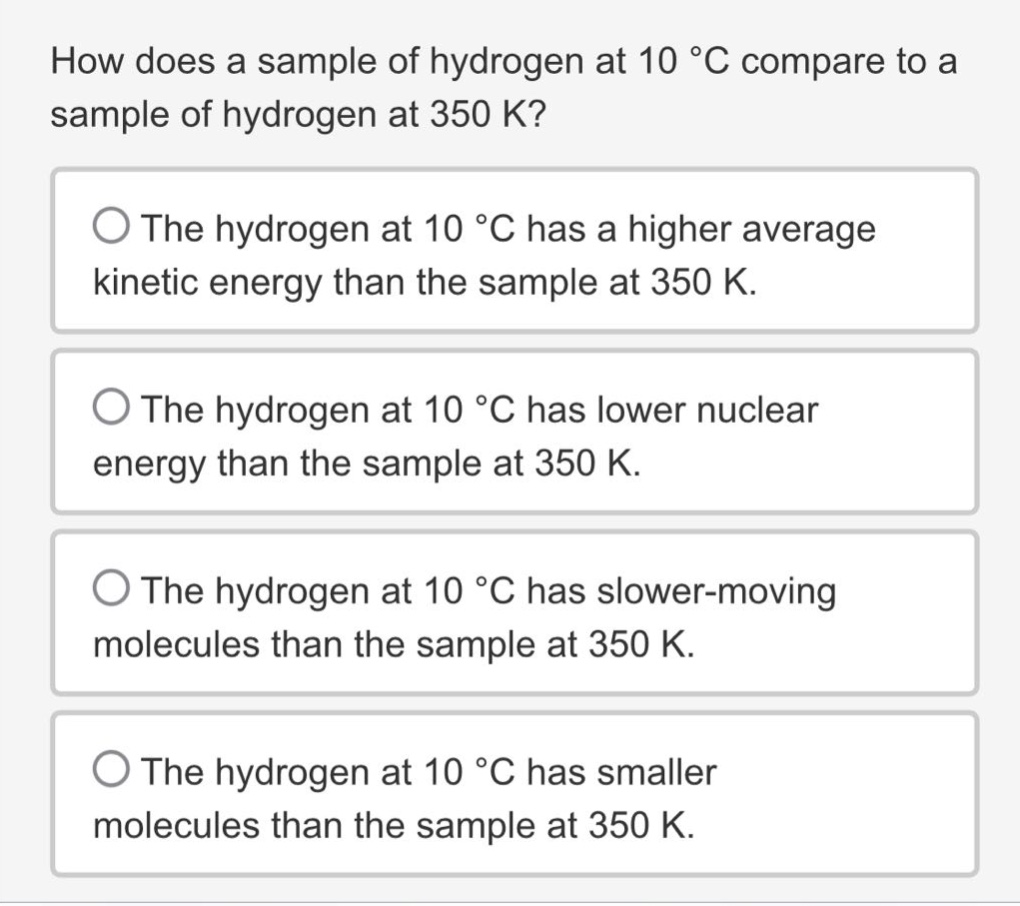
how does a sample of hydrogen at 10 °c compare to a sample of hydrogen at 350 k?\nthe hydrogen at 10 °c has a higher average kinetic energy than the sample at 350 k.\nthe hydrogen at 10 °c has lower nuclear energy than the sample at 350 k.\nthe hydrogen at 10 °c has slower - moving molecules than the sample at 350 k.\nthe hydrogen at 10 °c has smaller molecules than the sample at 350 k.
Answer
Explanation:
Step1: Convert 10 °C to Kelvin
Use the formula $K = °C+ 273.15$. So, $K = 10 + 273.15=283.15$ K.
Step2: Recall the relationship between temperature and molecular motion
Higher - temperature means higher average kinetic energy and faster - moving molecules. Since $283.15$ K ($10$ °C) < $350$ K, the hydrogen at $10$ °C has slower - moving molecules.
Answer:
The hydrogen at 10 °C has slower - moving molecules than the sample at 350 K.