a sample of a mysterious chemical substance naturally gains mass over time. the relationship between the…
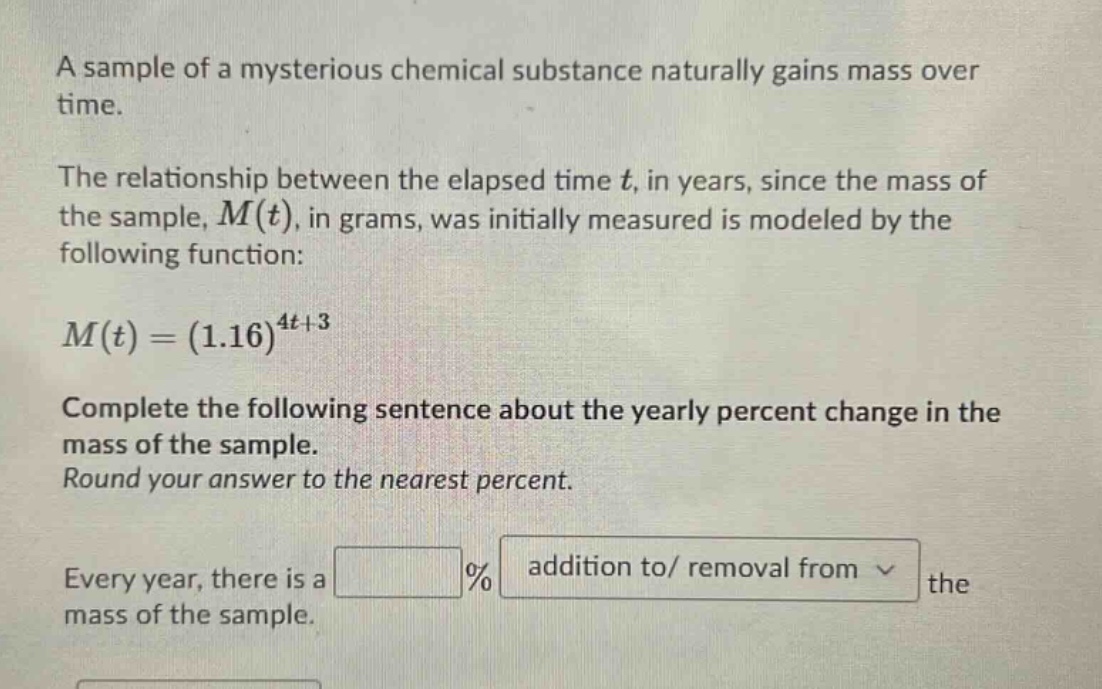
a sample of a mysterious chemical substance naturally gains mass over time. the relationship between the elapsed time t, in years, since the mass of the sample, m(t), in grams, was initially measured is modeled by the following function: m(t)=(1.16)^(4t + 3) complete the following sentence about the yearly percent change in the mass of the sample. round your answer to the nearest percent. every year, there is a % addition to/ removal from the mass of the sample.
Answer
Answer:
87, addition to
Explanation:
Step1: Rewrite the function
We have $M(t)=(1.16)^{4t + 3}=(1.16)^{3}\times(1.16)^{4t}$. Let's focus on the part related to the yearly - change. For an exponential function of the form $y = a(1 + r)^t$, we want to rewrite $(1.16)^{4t}$ in that form. If we let $y=(1.16)^{4t}$, and we know that $(1.16)^{4t}=(1.16^{4})^{t}$.
Step2: Calculate $1.16^{4}$
$1.16^{4}=1.16\times1.16\times1.16\times1.16\approx1.87$.
Step3: Determine the percent - change
Since the base of the exponential function $(1.16^{4})^{t}\approx1.87^{t}=(1 + 0.87)^{t}$, the value of $r = 0.87$. So the yearly percent change is $87%$, and since the base is greater than 1, it is an addition to the mass of the sample.