a sample of octane (c8h18) that has a mass of 0.750 g is burned in a bomb calorimeter. as a result, the…
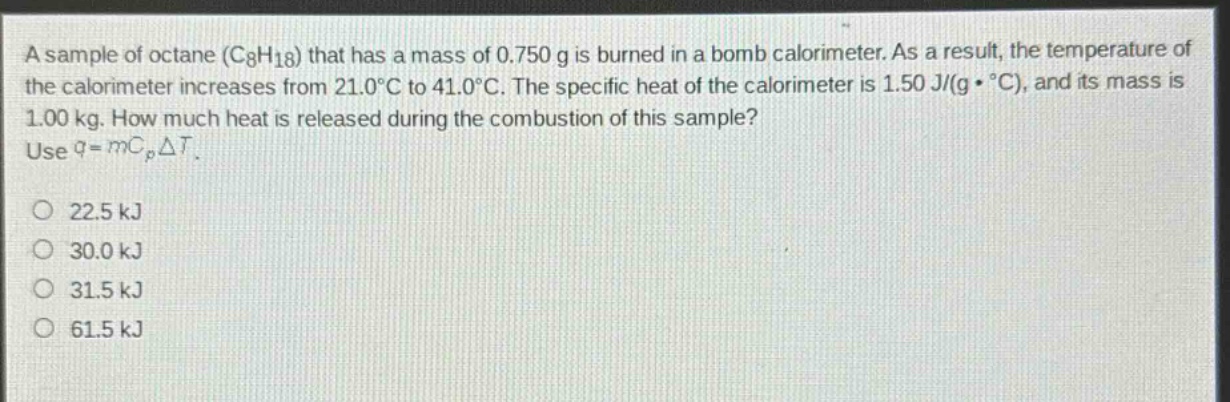
a sample of octane (c8h18) that has a mass of 0.750 g is burned in a bomb calorimeter. as a result, the temperature of the calorimeter increases from 21.0°c to 41.0°c. the specific heat of the calorimeter is 1.50 j/(g·°c), and its mass is 1.00 kg. how much heat is released during the combustion of this sample? use q = mc_pδt.\n\n22.5 kj\n30.0 kj\n31.5 kj\n61.5 kj
Answer
Explanation:
Step1: Identify given values
$m = 1.00\ kg=1000\ g$, $C_p = 1.50\ J/(g\cdot^{\circ}C)$, $\Delta T=T_2 - T_1=41.0^{\circ}C - 21.0^{\circ}C = 20.0^{\circ}C$
Step2: Apply heat - transfer formula
$q = mC_p\Delta T$ $q=1000\ g\times1.50\ J/(g\cdot^{\circ}C)\times20.0^{\circ}C$ $q = 30000\ J$
Step3: Convert to kJ
Since $1\ kJ = 1000\ J$, then $q=\frac{30000\ J}{1000}=30.0\ kJ$
Answer:
30.0 kJ