a sample of propane (c3h8) has a mass of 0.47 g. the sample is burned in a bomb calorimeter that has a mass…
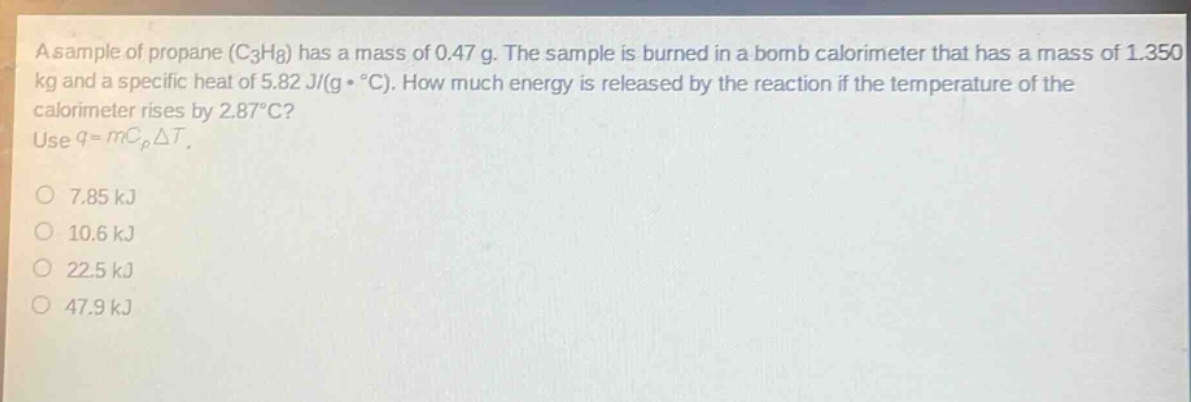
a sample of propane (c3h8) has a mass of 0.47 g. the sample is burned in a bomb calorimeter that has a mass of 1.350 kg and a specific heat of 5.82 j/(g·°c). how much energy is released by the reaction if the temperature of the calorimeter rises by 2.87°c? use q = mcpδt. 7.85 kj 10.6 kj 22.5 kj 47.9 kj
Answer
Explanation:
Step1: Convert mass of calorimeter to grams
The mass of the calorimeter $m = 1.350\ kg=1.350\times1000\ g = 1350\ g$.
Step2: Identify specific - heat and temperature change
The specific heat $C_p=5.82\ J/(g\cdot^{\circ}C)$ and the temperature change $\Delta T = 2.87^{\circ}C$.
Step3: Calculate heat released
Using the formula $q = mC_p\Delta T$, we substitute the values: $q=1350\ g\times5.82\ J/(g\cdot^{\circ}C)\times2.87^{\circ}C$. First, $1350\times5.82 = 7857$. Then, $7857\times2.87=22549.59\ J$. Convert to kJ: $q=\frac{22549.59}{1000}=22.54959\ kJ\approx22.5\ kJ$.
Answer:
22.5 kJ