which scenarios contradict ideal gas characteristics, representing deviations from kinetic - molecular…
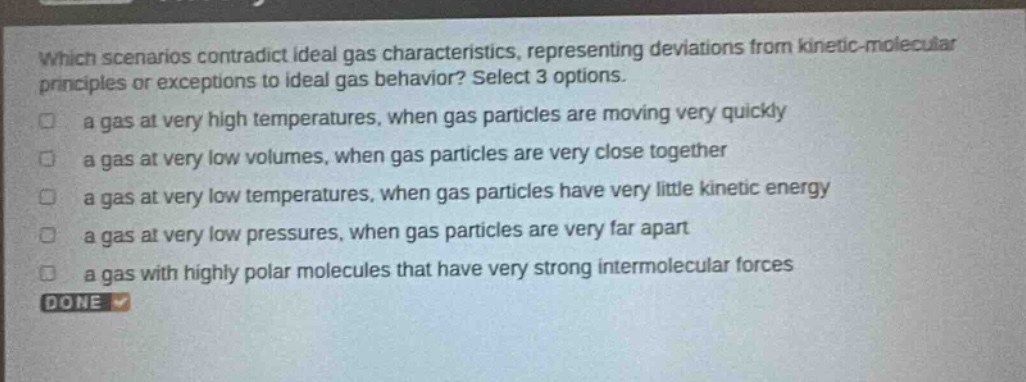
which scenarios contradict ideal gas characteristics, representing deviations from kinetic - molecular principles or exceptions to ideal gas behavior? select 3 options. a gas at very high temperatures, when gas particles are moving very quickly a gas at very low volumes, when gas particles are very close together a gas at very low temperatures, when gas particles have very little kinetic energy a gas at very low pressures, when gas particles are very far apart a gas with highly polar molecules that have very strong intermolecular forces done
Answer
Brief Explanations:
Ideal gas assumptions include negligible intermolecular forces and the volume of gas particles being negligible compared to the container volume. High - pressure and low - temperature conditions cause deviations. When gas particles are close together (low volume), intermolecular forces become significant. At low temperatures, particles have less kinetic energy and intermolecular forces are more impactful. Gases with highly polar molecules have strong intermolecular forces which violate ideal gas assumptions. High temperatures and low pressures are conditions where gases tend to behave ideally.
Answer:
- a gas at very low volumes, when gas particles are very close together
- a gas at very low temperatures, when gas particles have very little kinetic energy
- a gas with highly polar molecules that have very strong intermolecular forces