science eog review #11\nchemistry (8.p.1)\nshade in the most reactive nonmetals.\nearth history…
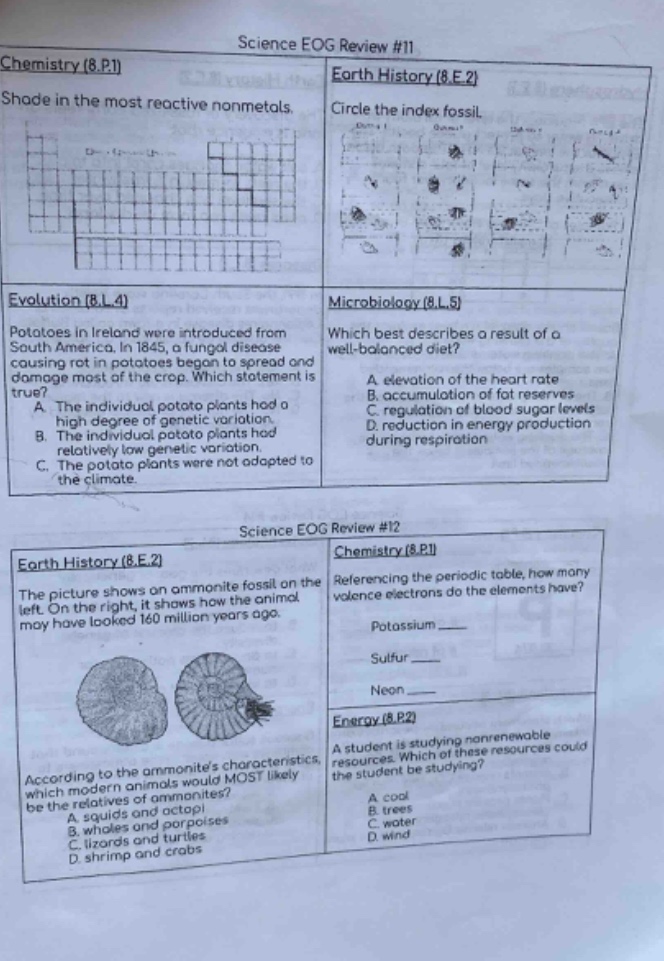
science eog review #11\nchemistry (8.p.1)\nshade in the most reactive nonmetals.\nearth history (8.e.2)\ncircle the index fossil.\nevolution (8.l.4)\npotatoes in ireland were introduced from south america. in 1845, a fungal disease causing rot in potatoes began to spread and damage most of the crop. which statement is true?\na. the individual potato plants had a high degree of genetic variation.\nb. the individual potato plants had relatively low genetic variation.\nc. the potato plants were not adapted to the climate.\nmicrobiology (8.l.5)\nwhich best describes a result of a well - balanced diet?\na. elevation of the heart rate\nb. accumulation of fat reserves\nc. regulation of blood sugar levels\nd. reduction in energy production during respiration\nscience eog review #12\nearth history (8.e.2)\nthe picture shows an ammonite fossil on the left. on the right, it shows how the animal may have looked 160 million years ago.\naccording to the ammonites characteristics, which modern animals would most likely be the relatives of ammonites?\na. squids and octopi\nb. whales and porpoises\nc. lizards and turtles\nd. shrimp and crabs\nchemistry (8.p.1)\nreferencing the periodic table, how many valence electrons do the elements have?\npotassium \nsulfur \nneon \nenergy (8.p.2)\na student is studying nonrenewable resources. which of these resources is the student studying?\na. coal\nb. trees\nc. water\nd. wind
Answer
Evolution (8.L.4)
Brief Explanations:
When a fungal disease spread in the Irish potato crop in 1845, the fact that it caused extensive damage indicates that the individual potato plants had relatively low genetic variation. Low genetic variation means less chance of having resistant individuals within the population.
Answer:
B. The individual potato plants had relatively low genetic variation.
Microbiology (8.L.5)
Brief Explanations:
A well - balanced diet provides the necessary nutrients for the body to function properly. One of the key functions it supports is the regulation of blood sugar levels.
Answer:
C. regulation of blood sugar levels
Earth History (8.E.2) - Ammonite fossil question
Brief Explanations:
Ammonites are cephalopods. Among the given options, squids and octopi are also cephalopods and are most likely to be related to ammonites based on their characteristics.
Answer:
A. squids and octopi
Chemistry (8.P.1) - Valence electrons question
Explanation:
Step1: Locate potassium in the periodic table
Potassium (K) is in Group 1. Elements in Group 1 have 1 valence electron.
Step2: Locate sulfur in the periodic table
Sulfur (S) is in Group 16. Elements in Group 16 have 6 valence electrons.
Step3: Locate neon in the periodic table
Neon (Ne) is in Group 18. Elements in Group 18 (noble gases) have 8 valence electrons (except helium which has 2).
Answer:
Potassium: 1 Sulfur: 6 Neon: 8
Energy (8.P.2)
Brief Explanations:
Non - renewable resources are those that cannot be replenished in a short period of time. Coal is a non - renewable fossil fuel, while trees, water, and wind are renewable resources.
Answer:
A. coal