for a science fair project about food and chemistry, bill looks around his kitchen for examples of covalent…
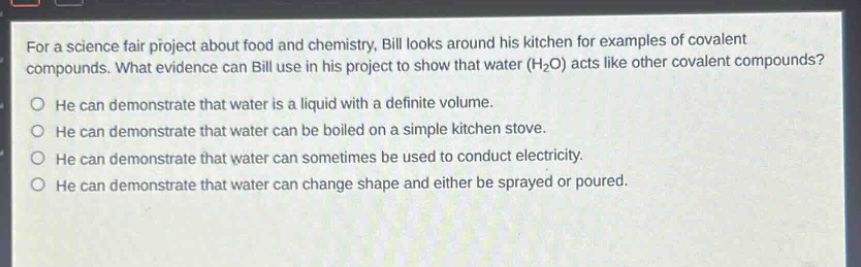
for a science fair project about food and chemistry, bill looks around his kitchen for examples of covalent compounds. what evidence can bill use in his project to show that water (h₂o) acts like other covalent compounds?\nhe can demonstrate that water is a liquid with a definite volume.\nhe can demonstrate that water can be boiled on a simple kitchen stove.\nhe can demonstrate that water can sometimes be used to conduct electricity.\nhe can demonstrate that water can change shape and either be sprayed or poured.
Answer
Answer:
He can demonstrate that water can be boiled on a simple kitchen stove.
Explanation:
Step1: Recall covalent - compound properties
Covalent compounds generally have relatively low boiling points.
Step2: Analyze each option
- Water being a liquid with a definite volume is a general property of liquids, not specific to covalent compounds.
- Water being able to be boiled on a simple kitchen stove shows its relatively low - boiling nature, which is a characteristic of covalent compounds.
- Pure water is a poor conductor of electricity. Impurities make it conduct, so this is not a characteristic property of covalent nature of water.
- Water changing shape and being sprayed or poured is a property of fluids in general, not specific to covalent compounds.