select the chemical equation that most likely represents the reaction between the vinegar and the…
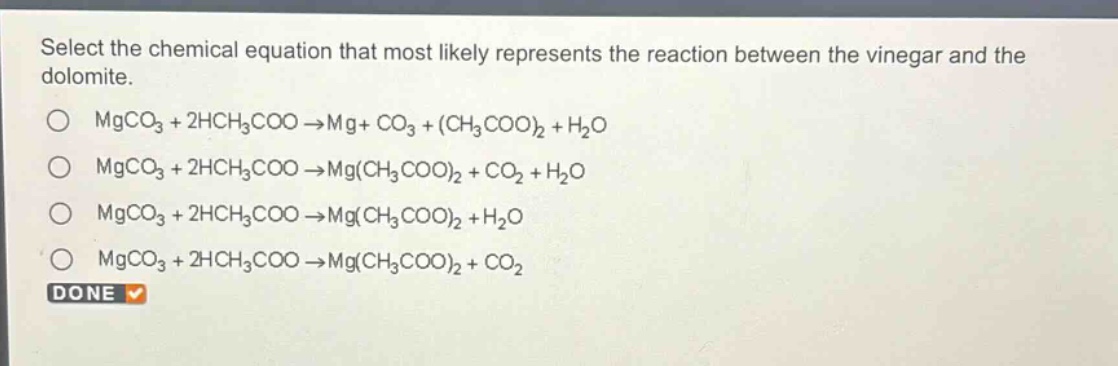
select the chemical equation that most likely represents the reaction between the vinegar and the dolomite.\no mgco₃ + 2hch₃coo → mg + co₃ + (ch₃coo)₂ + h₂o\no mgco₃ + 2hch₃coo → mg(ch₃coo)₂ + co₂ + h₂o\no mgco₃ + 2hch₃coo → mg(ch₃coo)₂ + h₂o\no mgco₃ + 2hch₃coo → mg(ch₃coo)₂ + co₂\ndone
Answer
Explanation:
Step1: Analyze carbonate - acid reaction
Carbonates react with acids to produce a salt, carbon dioxide and water. Vinegar contains acetic acid ($\text{CH}_3\text{COOH}$) and dolomite contains magnesium carbonate ($\text{MgCO}_3$).
Step2: Write the general reaction
The reaction between magnesium carbonate and acetic acid will form magnesium acetate ($\text{Mg(CH}_3\text{COO)}_2$), carbon dioxide ($\text{CO}_2$) and water ($\text{H}_2\text{O}$). The balanced chemical equation is $\text{MgCO}_3 + 2\text{CH}_3\text{COOH}\rightarrow\text{Mg(CH}_3\text{COO)}_2+\text{CO}_2+\text{H}_2\text{O}$.
Answer:
$\text{MgCO}_3 + 2\text{CH}_3\text{COOH}\rightarrow\text{Mg(CH}_3\text{COO)}_2+\text{CO}_2+\text{H}_2\text{O}$ (the second option)