select the correct answer\nwhich pair of elements can form ionic bonds?\na. copper (cu) and nitrogen (n)\nb…
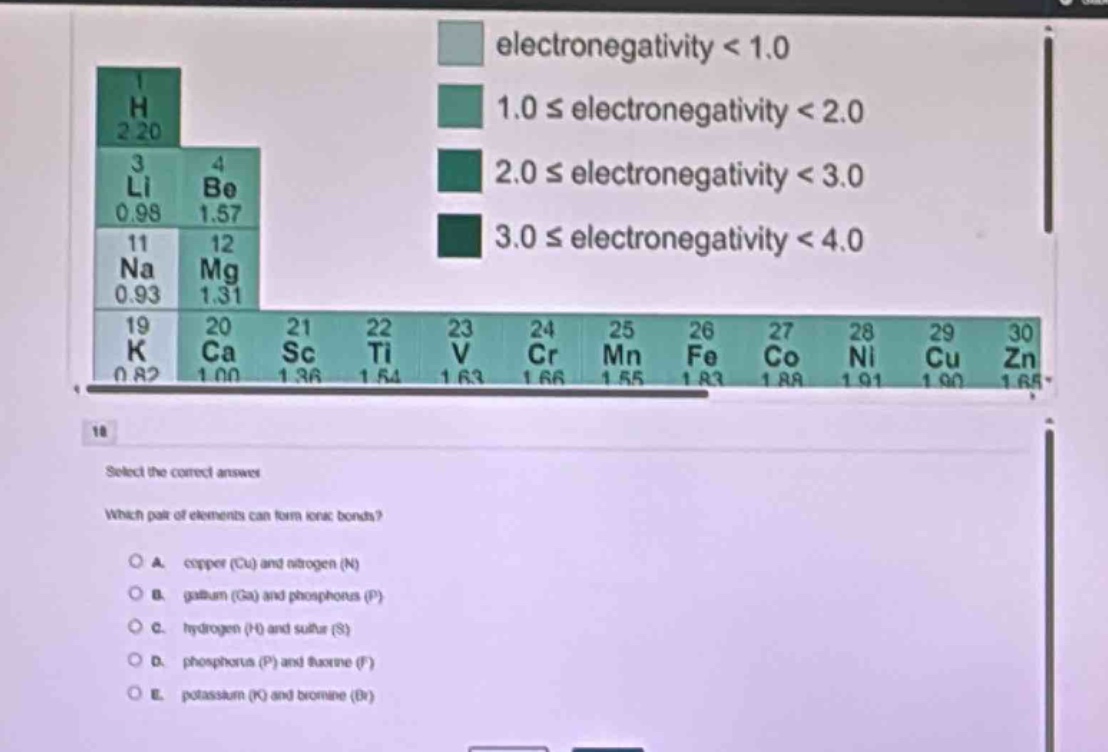
select the correct answer\nwhich pair of elements can form ionic bonds?\na. copper (cu) and nitrogen (n)\nb. gallium (ga) and phosphorus (p)\nc. hydrogen (h) and sulfur (s)\nd. phosphorus (p) and fluorine (f)\ne. potassium (k) and bromine (br)
Answer
Explanation:
Step1: Recall ionic - bond formation condition
Ionic bonds form between a metal and a non - metal with a large electronegativity difference (usually > 1.7).
Step2: Analyze option A
Copper (Cu) is a metal with electronegativity around 1.90, nitrogen (N) has an electronegativity of about 3.04. The electronegativity difference $\Delta\chi=3.04 - 1.90 = 1.14<1.7$.
Step3: Analyze option B
Gallium (Ga) is a metal with electronegativity around 1.81, phosphorus (P) has an electronegativity of about 2.19. The electronegativity difference $\Delta\chi=2.19 - 1.81 = 0.38<1.7$.
Step4: Analyze option C
Hydrogen (H) has an electronegativity of 2.20, sulfur (S) has an electronegativity of about 2.58. The electronegativity difference $\Delta\chi=2.58 - 2.20 = 0.38<1.7$.
Step5: Analyze option D
Phosphorus (P) has an electronegativity of 2.19, fluorine (F) has an electronegativity of 3.98. The electronegativity difference $\Delta\chi=3.98 - 2.19 = 1.79>1.7$, but both are non - metals.
Step6: Analyze option E
Potassium (K) is a metal with electronegativity 0.82, bromine (Br) is a non - metal with electronegativity 2.96. The electronegativity difference $\Delta\chi=2.96 - 0.82 = 2.14>1.7$.
Answer:
E. potassium (K) and bromine (Br)